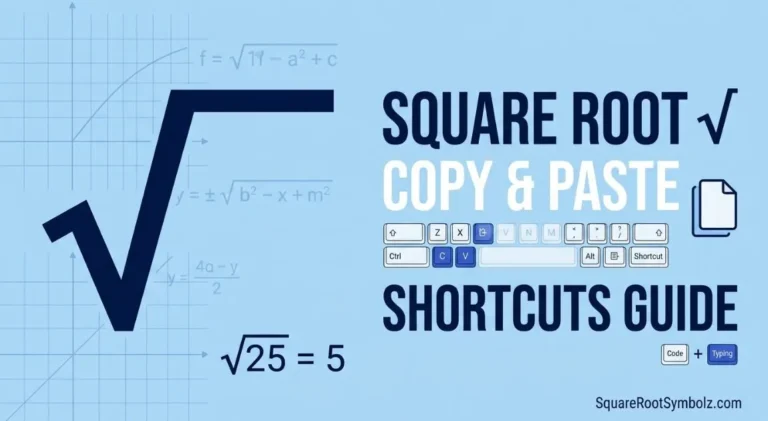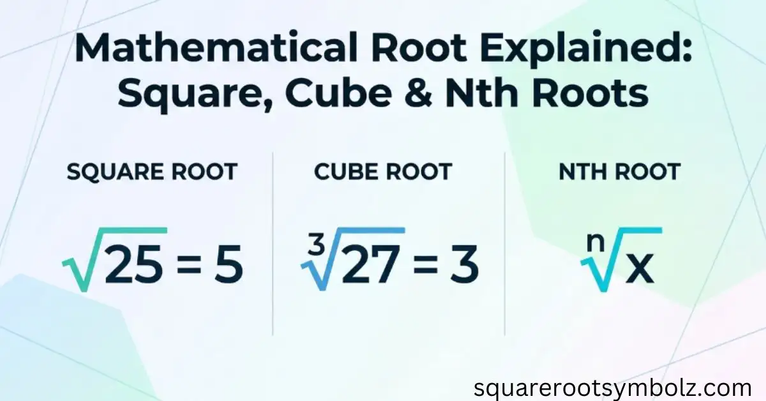
The formula for square root is √x = x½, meaning the square root is a value that produces the original number when multiplied by itself. If algebra, exponents, radicals, or perfect squares have ever felt confusing, this simple relationship makes them easier to understand.
After working through square root problems, one pattern becomes clear: students usually struggle because they memorize the radical sign without understanding the inverse relationship between squaring and roots. This guide explains the formula for square root, exponent form, perfect squares, variables, methods, and worked examples in a practical way.
What is the Square Root Formula?
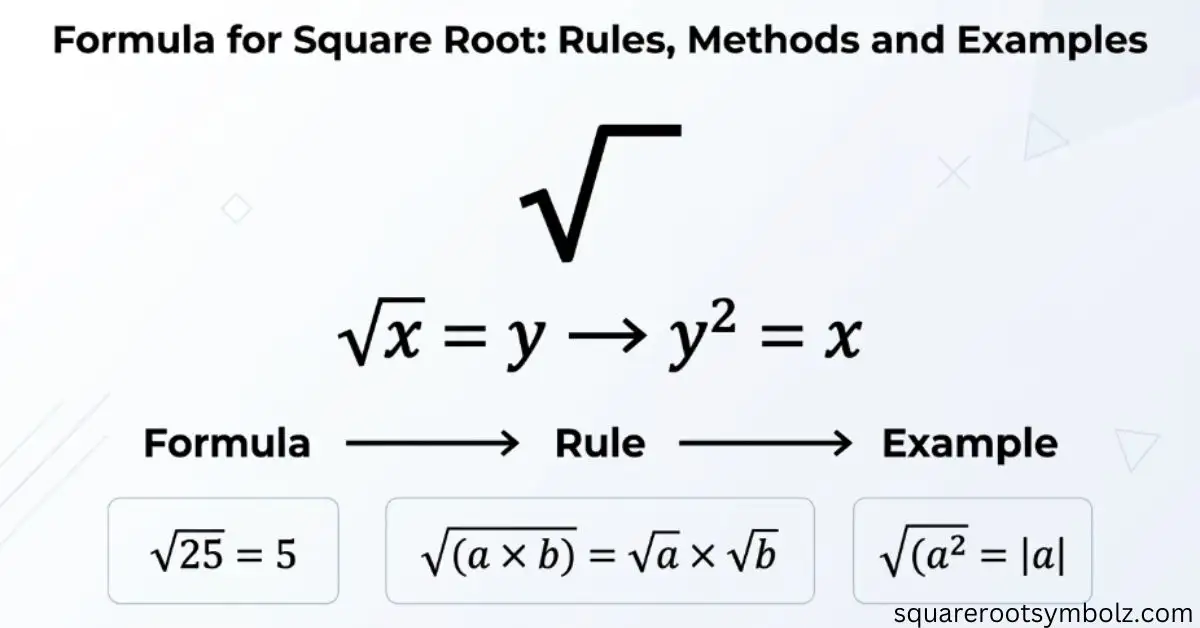
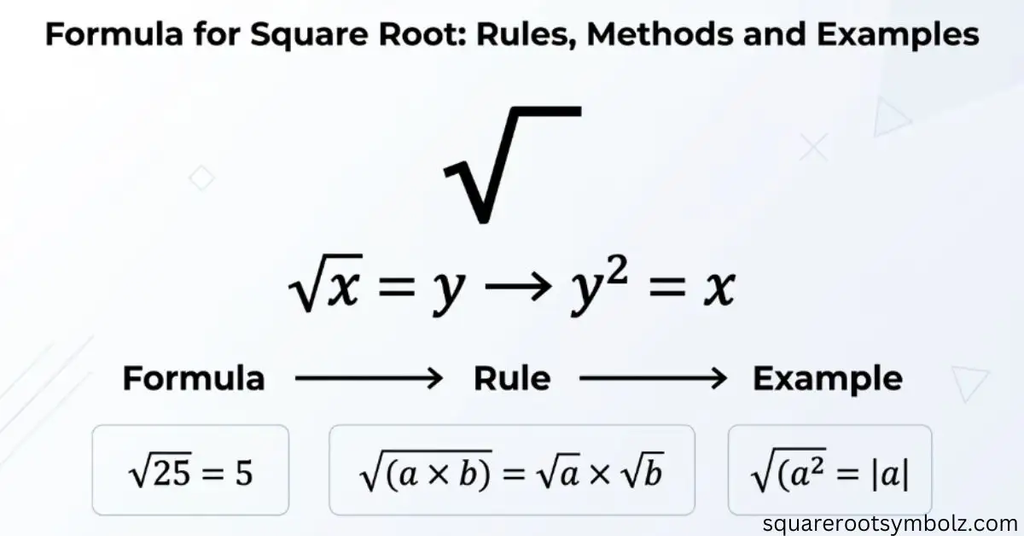
The square root formula describes the number that produces an original value when multiplied by itself. In mathematical notation, √x = y means that y² = x. The radical sign represents the operation, while the number inside the radical is called the radicand.
For example, √49 = 7 because 7 × 7 = 49. This inverse relationship between squaring and finding a square root is the foundation of many algebraic expressions. Understanding it helps students solve equations, simplify radicals, recognize perfect squares, and work confidently with exponents.
A useful detail is that a positive number has two values whose square is the same number. Both 5 and -5 square to 25. However, the radical expression √25 represents the principal, or non-negative, square root, which is 5.
Square Root Formula Expression and Variables
The standard formula for square root can be written in two equivalent forms:
√x = x½
This shows that taking a square root is mathematically the same as raising a non-negative number to the power of one-half. The radical expression and fractional exponent simply describe the same mathematical operation.
In the expression √x, the symbol √ is the radical sign and x is the radicand. If the answer is y, then y² must equal x. For a perfect square, the result is an integer. For many other numbers, such as √2, the answer is an irrational decimal.
Derivation of the Square Root Formula
The formula comes from reversing the operation of squaring. If y² = x, then taking the principal square root gives y = √x. Using exponent rules, x½ squared becomes x, which confirms why the power one-half represents a square root.
This relationship also explains an important rule: √a² = |a| for real numbers. The absolute value is necessary because the principal square root cannot be negative. For instance, √(-7)² equals 7, not -7.
Key Formula for Square Root
The most important formula is:
√x = x½
Another useful form is:
If x = y², then √x = |y|
These expressions connect radicals, exponents, perfect squares, and algebraic equations. They are especially useful when a number can be written as the square of another value.
Here are several related rules:
- √(ab) = √a × √b
- √(a/b) = √a / √b, when b is positive
- (√a)² = a
- √a² = |a|
These rules are useful for simplifying radical expressions and recognizing hidden perfect squares.
| Formula | Meaning | Example |
| √x = x½ | Radical and exponent forms are equivalent | √25 = 25½ = 5 |
| (√x)² = x | Squaring removes the radical | (√36)² = 36 |
| √(ab) = √a√b | Product rule | √(9 × 4) = 3 × 2 |
| √a² = |a| | Principal root is non-negative | √(-6)² = 6 |
Popular Methods to Find Square Root
The best method depends on the type of number. For a perfect square, mental calculation or prime factorization is often enough. For a non-perfect square, long division, estimation, or a calculator may be more practical.
Prime factorization works by breaking a number into prime factors and pairing identical factors. Long division can produce decimal answers, while estimation compares a number with nearby perfect squares. Each method connects back to the same formula for square root.
For example, 144 is easy because 12² = 144. But √50 is not an integer. Since 49 and 64 are nearby perfect squares, √50 must be slightly greater than 7 and much less than 8.
Step-by-Step Illustration
Let’s find the square root of 144.
First, write its prime factorization:
144 = 2 × 2 × 2 × 2 × 3 × 3
Now group identical factors into pairs:
(2 × 2)(2 × 2)(3 × 3)
Take one number from each pair:
2 × 2 × 3 = 12
Therefore:
√144 = 12
This method works because every pair represents a complete square factor. The process becomes especially useful when a perfect square is too large to recognize immediately.
Square Root Formula Solved Examples
Example 1: Find √81
Using the formula for square root:
√81 = x
We need a number whose square equals 81.
Since:
9 × 9 = 81
Therefore:
√81 = 9
Example 2: Find √225
We know:
15² = 15 × 15 = 225
Therefore:
√225 = 15
This example shows why memorizing common perfect squares can make calculations much faster.
Example 3: Simplify √72
First, find the largest perfect-square factor:
72 = 36 × 2
Then apply the product rule:
√72 = √36 × √2
Since √36 = 6:
√72 = 6√2
The formula for square root therefore helps simplify expressions even when the final answer is not a whole number.
Frequent Errors and Misunderstandings
One common mistake is assuming that every square root is a whole number. Numbers such as 4, 9, 16, and 25 are perfect squares, but values like 2, 3, and 10 have irrational square roots.
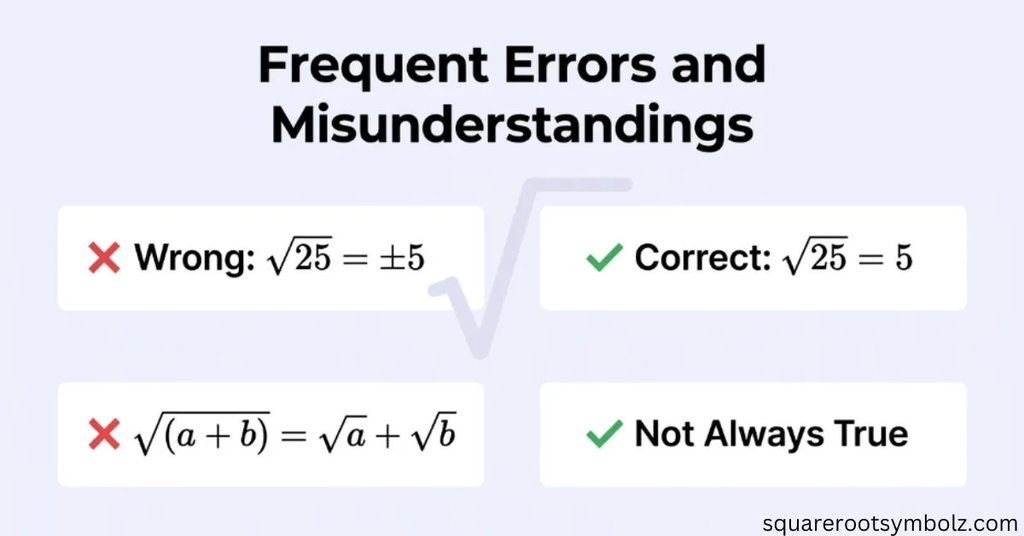
Another common error involves the difference between x² = 25 and √25. The equation x² = 25 has two solutions, x = ±5. However, √25 is the principal square root, so its value is 5.
Students also sometimes write:
√(a + b) = √a + √b
This is generally incorrect. For example:
√(9 + 16) = √25 = 5
But:
√9 + √16 = 3 + 4 = 7
Understanding the formula instead of memorizing symbols helps prevent these mistakes.
Relation to Other Concepts
The formula for square root appears throughout mathematics because square roots reverse squaring. In algebra, they help solve quadratic equations. In geometry, they appear when calculating lengths, diagonals, and distances.
The Pythagorean theorem provides a familiar example:
c = √(a² + b²)
Here, the square root converts the sum of two squared side lengths into the actual length of the hypotenuse. This same inverse relationship also appears in coordinate geometry, physics, statistics, and scientific calculations.
A good way to remember the concept is simple: squaring moves forward, while taking the square root moves backward. Once that relationship becomes clear, radicals, fractional exponents, equations, and geometric formulas start fitting together naturally.
Conclusion
The formula for square root is:
√x = x½
It means that the square root of a number is a value that produces the original number when multiplied by itself. For real numbers, the radical symbol gives the principal non-negative root.
The most useful approach is not simply memorizing the formula. Learn the relationship between squares, exponents, radicals, perfect squares, and inverse operations. Once that connection is understood, finding and simplifying square roots becomes much easier.
FAQ Section
What is the formula for square root?
The basic formula is √x = x½. It means the square root of x is the same as raising x to the power of one-half.
How do you calculate a square root?
You can use mental calculation for perfect squares, prime factorization, long division, estimation, or a calculator for more difficult values.
What is the square root of 49?
The principal square root of 49 is 7 because 7 × 7 = 49.
Why does 25 have two square roots?
Both 5 and -5 produce 25 when squared. However, √25 = 5 because the radical symbol represents the principal non-negative square root.
What is the square root formula in exponent form?
The exponent form is x½, which is equivalent to √x.
Can a negative number have a real square root?
No. A negative number does not have a real square root because no real number multiplied by itself produces a negative result. Complex numbers extend this idea using the imaginary unit.

I’m the creator of SquareRootSymbolz.com, where I publish easy-to-understand guides on symbols, Unicode characters, Alt codes, keyboard shortcuts, and copy-and-paste text symbols. My goal is to provide accurate, well-researched, and user-friendly content that helps readers quickly find the information they need.