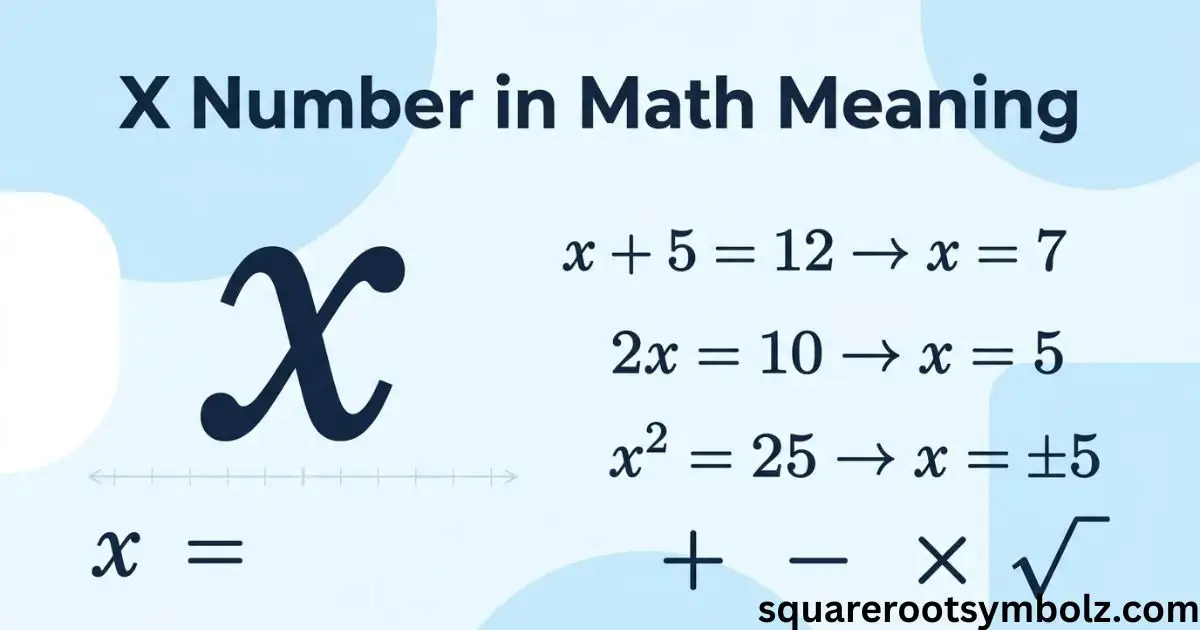
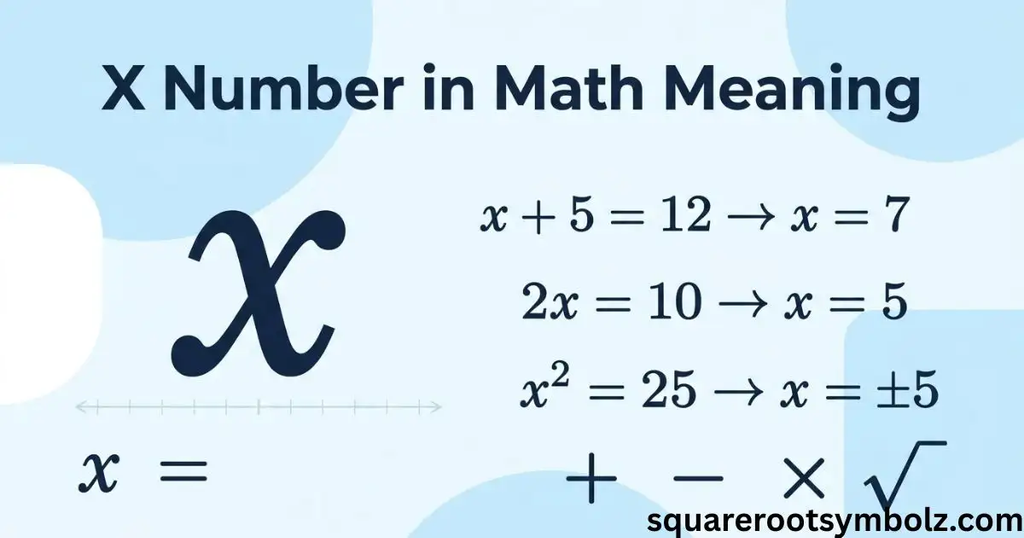
The mathematical interpretation of x number is straightforward: x is commonly used as a variable to represent a number or quantity whose value is unknown or allowed to change. In algebra, you might see x in an expression such as 3x + 5 or an equation such as 2x = 10. The actual value depends on the context.
If the phrase “x number” feels confusing, you are not alone. Beginners often see the letter x and wonder whether it means multiplication, an unknown number, or something else. The key is to look at its position and context. Once you understand variable, value, expression, equation, constant, and coefficient, x becomes much easier to read and use.
What are Algebraic Expressions?
An algebraic expression combines numbers, variables, and mathematical operations such as addition, subtraction, multiplication, or division. For example, 3x + 5 is an algebraic expression. Here, x can represent a number, while 3 and 5 provide fixed numerical information within the expression.
When someone says “x number of books,” x represents the number of books when that quantity has not been specified. For example, if one box contains 12 books, then x boxes contain 12x books. The same idea works for money, distance, objects, time, or any measurable quantity.
The important point is that an expression does not necessarily tell you the value of x. It describes a mathematical relationship involving x. If a problem later tells you that x = 4, you can substitute 4 into the expression and calculate the resulting numerical value.
Variables, Constants, Terms, and Coefficients
In the expression 5x + 7, x is the variable because its value can vary or is not yet specified. The number 7 is a constant. The number 5 is the coefficient because it multiplies x. These parts work together to communicate a mathematical relationship clearly.
A variable does not always mean an unknown value that must eventually be solved. Sometimes it represents a quantity that is allowed to change. For example, if x represents the number of tickets sold, x could be 10, 20, 50, or another permitted value depending on the situation.
| Part | Example in 5x + 7 | Meaning |
| Variable | x | Quantity that may vary |
| Coefficient | 5 | Number multiplying x |
| Constant | 7 | Fixed numerical value |
| Term | 5x | Part separated by + or − |
| Expression | 5x + 7 | Complete mathematical statement |
This distinction becomes especially useful when reading longer algebra problems. Instead of viewing x as a mysterious letter, think of it as a label attached to a quantity. Its meaning comes from the problem.
A bit more detail
A helpful way to understand x number is to imagine x as an empty container. The container has a name, x, but its contents can change. If x = 3, the container currently holds 3. If x = 10, it currently holds 10. The symbol stays the same while the value changes.
Suppose a parking garage charges $4 per hour. If x represents the number of hours, the cost can be written as 4x. For two hours the cost is $8, while for five hours it is $20. The variable makes one expression useful for many possible values.
This is why algebra is powerful. Instead of writing a separate calculation for every possible quantity, one variable can represent an entire range of possibilities. LibreTexts uses a similar model by treating x as something that can hold different numerical values within a particular context.
Mathematical Expressions
A mathematical expression can contain numbers, variables, and operations without necessarily stating an equality. Examples include x + 4, 3x, x² − 7, and 12 ÷ x. Each expression communicates a calculation or relationship, but the value depends on the variable.
For example, if x represents the number of pencils in one box, then 5x can represent the number of pencils in five identical boxes. If x = 12, the expression becomes 5 × 12 = 60. The expression therefore connects a general situation with a specific numerical result.
| Expression | If x = 4 | Value |
| x + 3 | 4 + 3 | 7 |
| 2x | 2 × 4 | 8 |
| x² | 4² | 16 |
| 10 − x | 10 − 4 | 6 |
One important distinction is that an expression is not automatically an equation. An equation uses an equal sign to state that two mathematical quantities have the same value. That difference becomes important when you begin solving for x.
Translating an English Phrase Into an Algebraic Expression
When a word problem says “x number of items,” the x normally represents the quantity of items. The surrounding words tell you what operation to perform. Phrases such as “more than,” “less than,” “times,” “product,” and “total” provide clues about the mathematical structure.
For example, “five times a number” becomes 5x. “Five more than a number” becomes x + 5. “Three less than a number” becomes x − 3. In each case, x stands for the number that was not specifically given.
| English phrase | Algebraic form |
| A number | x |
| Five times a number | 5x |
| Five more than a number | x + 5 |
| Five less than a number | x − 5 |
| Twice a number | 2x |
| A number divided by 4 | x/4 |
WTAMU’s algebra tutorial follows this same translation process: identify the mathematical operation, identify the unknown quantity, replace the unknown with a variable, and construct the expression.
This skill is more useful than memorizing isolated examples. Once you recognize that “a number” can be represented by x, many word problems become easier to translate into algebra.
Simplifying Algebraic Expressions
Simplifying an algebraic expression means rewriting it in an equivalent, more manageable form. A common technique is combining like terms, which are terms containing the same variable raised to the same power. For example, 3x + 2x becomes 5x.
Consider 4x + 7 − x + 3. The x terms combine to give 3x, while the constants 7 and 3 combine to give 10. The simplified expression is therefore 3x + 10. The value of x does not need to be known to perform this simplification.
Multiplication and division require different steps. For example, 2x × 3 simplifies to 6x. The key is to preserve the mathematical relationship represented by the original expression rather than changing its meaning.
Simplifying becomes especially important when solving equations because a cleaner expression makes the unknown easier to isolate. It is one of the foundational skills connecting basic arithmetic to algebra.
Algebraic Expressions Examples
Consider a real-life example. A movie ticket costs $12, and you buy x tickets. The total cost is 12x dollars. If you buy 3 tickets, x = 3 and the total becomes $36. If you buy 7 tickets, the same expression gives $84.
Another example involves distance. If a cyclist travels 15 miles each hour for x hours, the total distance can be written as 15x miles. When x = 4, the distance is 60 miles. The variable allows the same formula to work for different travel times.
| Situation | Expression | If x = 5 |
| $12 per ticket | 12x | $60 |
| 15 miles per hour | 15x | 75 miles |
| 8 books per box | 8x | 40 books |
| $20 saved each week | 20x | $100 |
Cuemath similarly uses everyday quantities to show how a variable can represent the number of bags, items, or other quantities in a situation.
The lesson is simple: when the exact quantity is not fixed, x can provide a compact mathematical way to represent it.
Formulas
A formula is an equation that expresses a relationship between quantities. Variables are particularly useful in formulas because they allow the same relationship to work for many different values.
For example, the perimeter of a rectangle can be written as P = 2l + 2w, where P is perimeter, l is length, and w is width. Each letter represents a quantity with a specific meaning. The variables are not random placeholders; the context gives them meaning.
Other familiar formulas include A = lw for the area of a rectangle and d = rt for distance when d represents distance, r represents rate, and t represents time. If you know some values, you can substitute them into the formula.
The important idea for x number is that x can be one of the variables in a formula. Its exact meaning depends on what the formula describes.
Solving a Formula for a Specified Variable
Solving for x means rearranging an equation so that x is isolated on one side. The goal is not simply to move symbols around; each operation must preserve equality. This is why algebra uses inverse operations such as addition and subtraction or multiplication and division.
For example:
2x + 6 = 20
Subtract 6 from both sides:
2x = 14
Divide both sides by 2:
x = 7
The unknown number represented by x is therefore 7. You can verify the result by substituting 7 back into the original equation: 2(7) + 6 = 20.
The same principle works with more complicated equations. The number of steps may increase, but the central goal remains the same: isolate the specified variable while maintaining an equivalent equation.
Practice Questions on Algebraic Expressions
Try these without looking at the answers first.
Question 1
Write an algebraic expression for six times a number.
Answer: 6x
Question 2
Write an expression for a number increased by 9.
Answer: x + 9
Question 3
A notebook costs $4. You buy x notebooks. Write the total cost.
Answer: 4x
Question 4
If x = 8, evaluate 3x + 2.
Answer:
3(8) + 2 = 24 + 2 = 26
Question 5
If 4x = 28, find x.
Answer:
x = 28 ÷ 4
x = 7
Practice is where the meaning of x becomes automatic. At first, you may stop and think about what the letter represents. With repeated examples, you begin to recognize variables, constants, coefficients, expressions, and equations almost immediately.
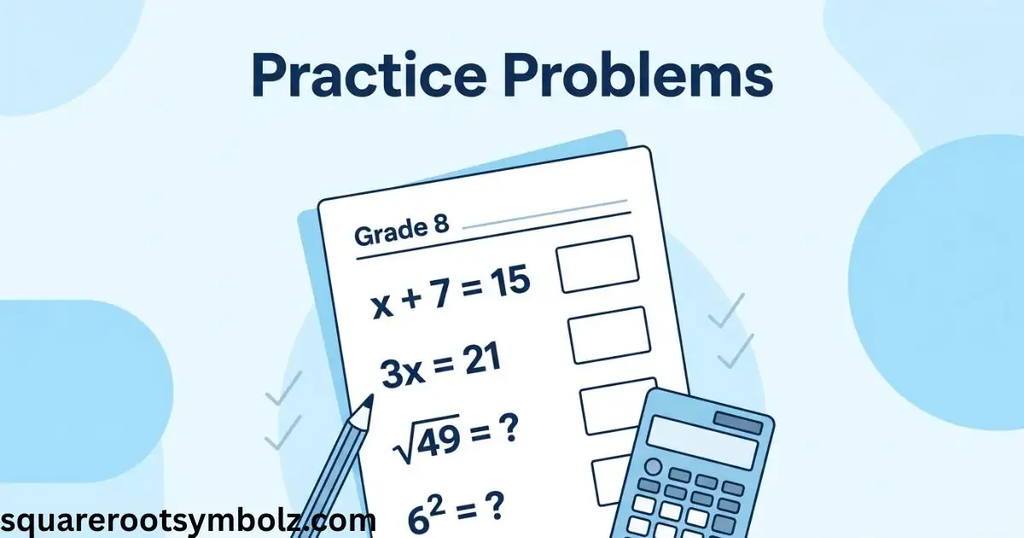
Practice Problems
Work through these problems independently.
- Write an algebraic expression for twice a number plus 5.
- If x = 6, evaluate 4x − 3.
- A movie ticket costs $11. Write an expression for x tickets.
- Solve x + 12 = 25.
- Solve 5x = 45.
- A rectangle has width x and length 10. Write its area.
- If 3x + 4 = 19, find x.
Answers
- 2x + 5
- 21
- 11x
- x = 13
- x = 9
- 10x
- x = 5
The best habit is to identify what x represents before performing calculations. In a word problem, the answer is not always simply “x = ….” You should check what x stands for and make sure the final answer addresses the actual question.
Conclusion
X number in mathematics usually refers to a number or quantity represented by the variable x. Depending on the context, x may be an unknown value that you need to find, or it may represent a quantity that can change.
For example, in 2x + 5, x is a variable, 2 is the coefficient, and 5 is the constant. In 2x = 14, x represents the unknown number and can be found by solving the equation.
The most useful mental model is simple: x is a label for a number whose value depends on the problem. Once you understand that relationship, algebraic expressions, formulas, word problems, and equations become much easier to interpret.
FAQ Section
What does x number mean in math?
In math, x number generally means that x is being used to represent a number or quantity. The value may be unknown, variable, or determined by the context.
What does x represent?
x commonly represents an unknown or changing quantity. For example, in 2x + 3, x could represent any permitted numerical value unless additional information defines it.
Is x always an unknown number?
No. x can represent an unknown value that must be solved, but it can also represent a known value that changes between calculations. Once a value such as x = 5 is specified, x is no longer unknown in that particular calculation.
Why is x used for an unknown number?
There is no mathematical rule requiring x specifically. Other letters can represent variables too, including a, b, y, z, n, and t. x became a common convention in algebra and is widely recognized as a variable.
What is x in 5x?
In 5x, x is the variable and 5 is its coefficient. The expression means 5 multiplied by x.
What is the difference between x and a number?
A number such as 7 has a fixed numerical value. x is a symbol whose value depends on the mathematical context. For example, x could equal 7 in one problem and 12 in another.
How do you find the value of x?
You find x by using the information in an equation or problem. For example, if x + 4 = 10, subtract 4 from both sides to get x = 6.
Can x represent zero?
Yes. Unless a problem gives a restriction, x can represent zero. For example, if x represents the number of tickets sold, whether zero is allowed depends on the situation.

I’m the creator of SquareRootSymbolz.com, where I publish easy-to-understand guides on symbols, Unicode characters, Alt codes, keyboard shortcuts, and copy-and-paste text symbols. My goal is to provide accurate, well-researched, and user-friendly content that helps readers quickly find the information they need.