
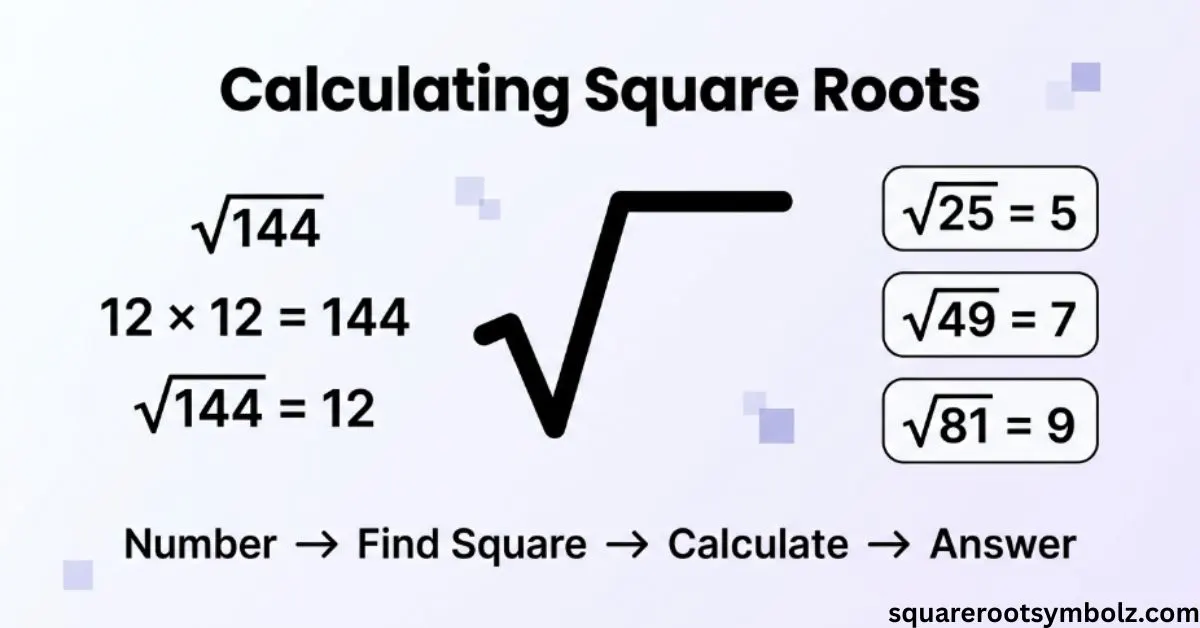
Calculating square roots means finding the number that produces a given value when multiplied by itself. For example, √25 = 5 because 5 × 5 = 25. If you are stuck between a perfect square and a decimal answer, the key is knowing whether the number has an exact root or needs an approximation.
After years of explaining basic mathematics, one pattern is clear: students usually struggle not because square roots are difficult, but because they do not know where to start. This guide connects perfect squares, estimation, decimal approximations, calculators, initial guesses, and manual methods so you can choose the right approach confidently.
Square Roots
A square root reverses the process of squaring. If 6² = 36, then √36 = 6. In general, the square root of a nonnegative number is the value that, when multiplied by itself, produces that number. The radical symbol √ represents the principal square root.
For example, 4 × 4 = 16, so √16 = 4. Likewise, 9 × 9 = 81, giving √81 = 9. Remember that an equation such as x² = 25 has two solutions, 5 and −5, but the symbol √25 refers specifically to the principal square root, which is 5.
| Number | Square root | Check |
| 1 | 1 | 1 × 1 = 1 |
| 4 | 2 | 2 × 2 = 4 |
| 9 | 3 | 3 × 3 = 9 |
| 16 | 4 | 4 × 4 = 16 |
| 25 | 5 | 5 × 5 = 25 |
| 36 | 6 | 6 × 6 = 36 |
| 49 | 7 | 7 × 7 = 49 |
| 64 | 8 | 8 × 8 = 64 |
| 81 | 9 | 9 × 9 = 81 |
| 100 | 10 | 10 × 10 = 100 |
Perfect Squares
Perfect squares make calculating square roots much easier because their roots are whole numbers. A perfect square is produced by multiplying an integer by itself. Examples include 1, 4, 9, 16, 25, 36, 49, 64, 81, and 100. Memorizing common squares can make mental math dramatically faster.
A useful benchmark list is:
1² = 1
2² = 4
3² = 9
4² = 16
5² = 25
6² = 36
7² = 49
8² = 64
9² = 81
10² = 100
11² = 121
12² = 144
13² = 169
14² = 196
15² = 225
These numbers act like landmarks. If you know them, you can quickly determine where a non-perfect square belongs. For instance, because 16 < 20 < 25, you immediately know that √20 must be between 4 and 5.
Calculating Square Roots
The easiest case is a perfect square. Find the integer that multiplies by itself to produce the number. For example:
√144 = 12
because:
12 × 12 = 144
The challenge begins with non-perfect squares such as √10 or √17. These do not have simple whole-number roots. Instead, you can locate the number between two known perfect squares and then refine the answer.
Example: what’s √10?
Since 3² = 9 and 4² = 16, √10 must lie between 3 and 4. Try 3.1:
3.1 × 3.1 = 9.61
Then try 3.2:
3.2 × 3.2 = 10.24
Therefore, √10 is between 3.1 and 3.2. Its decimal value is approximately 3.16227766, so to three decimal places, √10 ≈ 3.162. This is an approximation because √10 is irrational.
Approximating and Calculating Square Roots
When a number is not a perfect square, comparing it with nearby perfect squares is one of the simplest manual techniques. Suppose you need √17. The surrounding perfect squares are 16 and 25, whose roots are 4 and 5. Therefore, √17 must fall between 4 and 5.
You can then test decimal values. For example:
4.1² = 16.81
and
4.2² = 17.64
So 4.1 is closer to 17 than 4.2. Testing more precise values gives:
4.12² = 16.9744
4.13² = 17.0569
Therefore:
√17 ≈ 4.123
The important idea is not memorizing the decimal. It is learning how to bracket the answer between two known square roots and refine it.
A quick estimation rule
For a number N, find consecutive perfect squares:
a² < N < b²
Then:
a < √N < b
For example:
64 < 73 < 81
so:
8 < √73 < 9
That already gives you a useful estimate before doing any calculator work.
The Easiest Way to Calculate a Square Root
For everyday calculations, a calculator is usually the fastest and most reliable choice. Enter the number and use the square-root function, commonly represented by √. For example, entering 225 and applying the square-root operation gives 15.
But a calculator should not replace estimation. Before accepting an answer, ask whether it makes sense. If you calculate √80 and receive a value greater than 10, something went wrong because 9² = 81. Since 80 is just below 81, its square root should be just below 9.
This quick reasonableness check is especially useful in schoolwork, spreadsheets, engineering calculations, and any situation where a misplaced decimal can change the result significantly.
A Fun Way to Calculate a Square Root
A useful manual technique is the divide-and-average method, also known as the Babylonian method and closely related to Newton’s method. Start with an estimate, divide the original number by that estimate, and average the two values. Repeating the process rapidly improves the approximation.
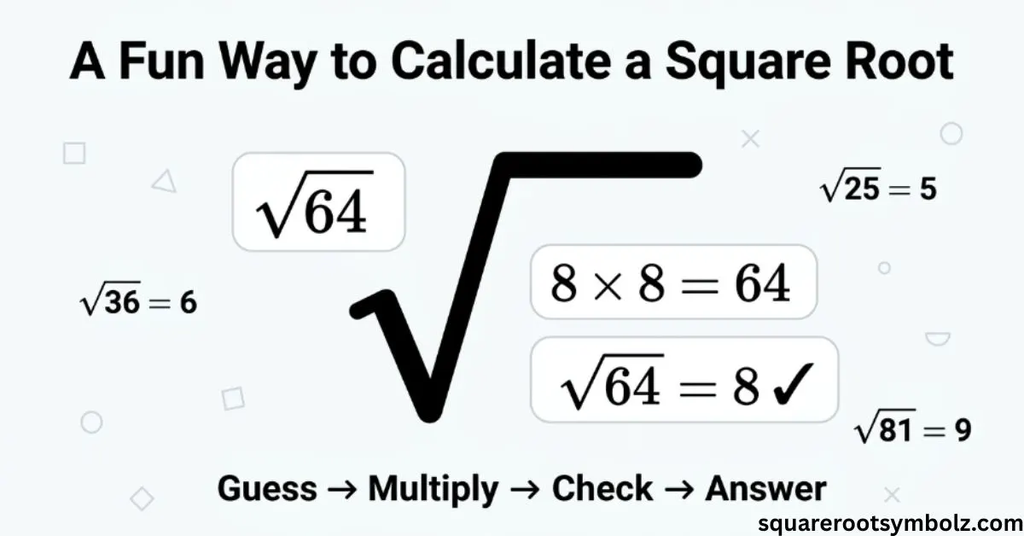
To estimate √10, start with 4:
10 ÷ 4 = 2.5
Average 4 and 2.5:
(4 + 2.5) ÷ 2 = 3.25
Use 3.25 as the next estimate:
10 ÷ 3.25 ≈ 3.0769
Average again:
(3.25 + 3.0769) ÷ 2 ≈ 3.16345
One more iteration gets very close to:
√10 ≈ 3.16228
This is powerful because each cycle moves the estimate rapidly toward the actual root.
How to Guess
A good starting guess can make manual calculating square roots much faster. One simple strategy is to look at the nearby perfect squares. For √38, for example, 36 = 6² and 49 = 7², so 6 is already an excellent starting point. John D. Cook shows that selecting a nearby square can substantially reduce the initial error.
For larger numbers, look at their size first. If the number has five digits, its square root will generally have around three digits. Then use familiar perfect squares to narrow the starting point.
For example:
300² = 90,000
400² = 160,000
Therefore, √100,000 must lie between 300 and 400.
That kind of quick estimation gives you a sensible starting point before applying a more precise method.
Initial guess
The quality of an initial guess matters when you calculate square roots iteratively. John D. Cook discusses using either the floor or ceiling of the true root as a starting point and choosing the estimate whose square is closer to the target number.
Consider √38. The neighboring perfect squares are:
6² = 36
7² = 49
Because 38 is much closer to 36, beginning with 6 is better than beginning with 7. Applying the averaging formula
(g + x/g) ÷ 2
with x = 38 and g = 6 gives approximately 6.167, already extremely close to the actual value.
This illustrates an important principle: you do not need a perfect first guess. You need a reasonable one that allows the next calculation to move rapidly toward the answer.
Initial accuracy
Accuracy depends partly on the initial estimate and partly on how many refinement steps you perform. For manual calculation, a nearby perfect square provides a strong benchmark. For calculator-based work, the machine can supply many decimal places, although you should normally round according to the requirements of the problem.
For example:
√10 = 3.162277660…
If a problem asks for the nearest whole number:
√10 ≈ 3
To the nearest tenth:
√10 ≈ 3.2
To three decimal places:
√10 ≈ 3.162
The correct number of decimal places depends on the question. Giving too many digits can create unnecessary clutter, while rounding too early can reduce accuracy.
Conclusion
Calculating square roots becomes much easier once you recognize whether the number is a perfect square or requires an approximation. Perfect squares such as 25, 36, and 100 have exact integer roots, while numbers such as 10 and 17 require decimal approximation or a radical form.
For quick answers, use a calculator and verify the result by squaring it. For mental or pencil-and-paper work, use nearby perfect squares to create an initial estimate, then refine it with trial-and-error or the divide-and-average method. With these techniques, even unfamiliar square roots become manageable.
FAQ Section
What is the easiest way to calculate a square root?
For a perfect square, identify the number that multiplies by itself to produce the original number. For non-perfect squares, use a calculator or estimate the root between two consecutive perfect squares.
How do you calculate a square root without a calculator?
Find two nearby perfect squares, place the answer between their roots, and test decimal values. You can also use the divide-and-average method for faster manual approximation.
What is a perfect square?
A perfect square is a number produced by multiplying an integer by itself. Examples include 1, 4, 9, 16, 25, and 36.
How do you calculate √17?
Because 16 < 17 < 25, √17 lies between 4 and 5. Refining the estimate gives √17 ≈ 4.123.
How do you calculate √10?
Because 9 < 10 < 16, √10 is between 3 and 4. A more precise value is √10 ≈ 3.16227766.
Is every square root a whole number?
No. Only perfect squares have integer square roots. Many other positive numbers have irrational square roots whose decimal expansions continue without terminating or repeating.
What happens when a square root is rounded?
Rounding changes the exact value into an approximation. For example, √10 is approximately 3.162 when rounded to three decimal places.
Can you calculate square roots by hand?
Yes. Perfect squares can often be recognized immediately, while non-perfect roots can be estimated using nearby squares, trial and error, or iterative methods such as Newton’s method.

I’m the creator of SquareRootSymbolz.com, where I publish easy-to-understand guides on symbols, Unicode characters, Alt codes, keyboard shortcuts, and copy-and-paste text symbols. My goal is to provide accurate, well-researched, and user-friendly content that helps readers quickly find the information they need.



One Comment