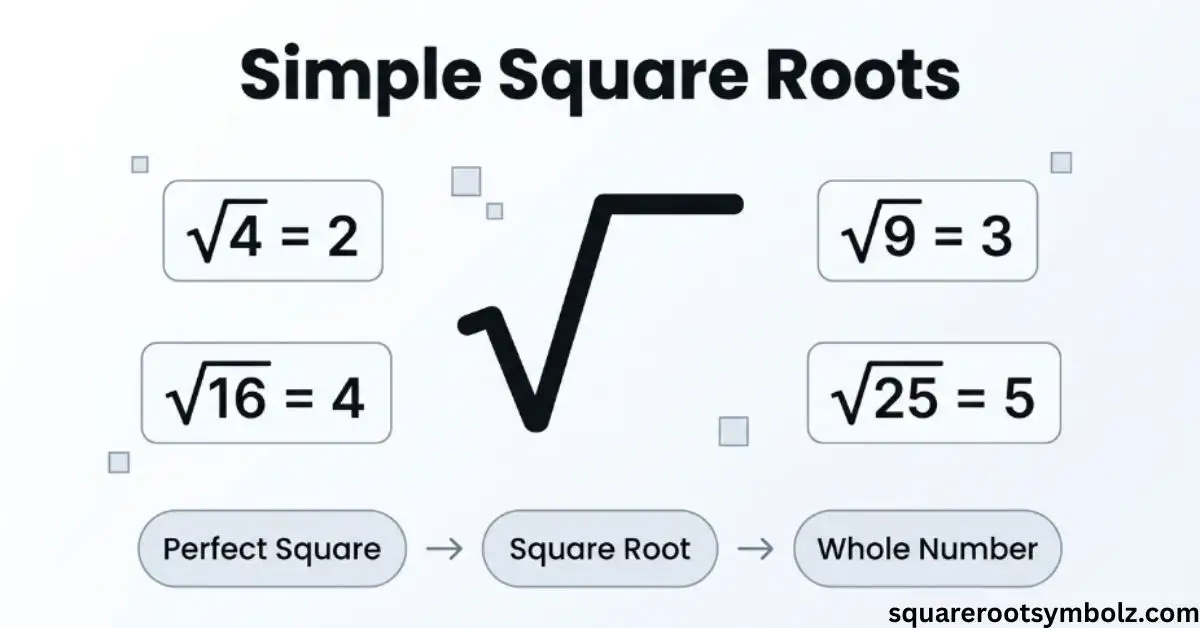
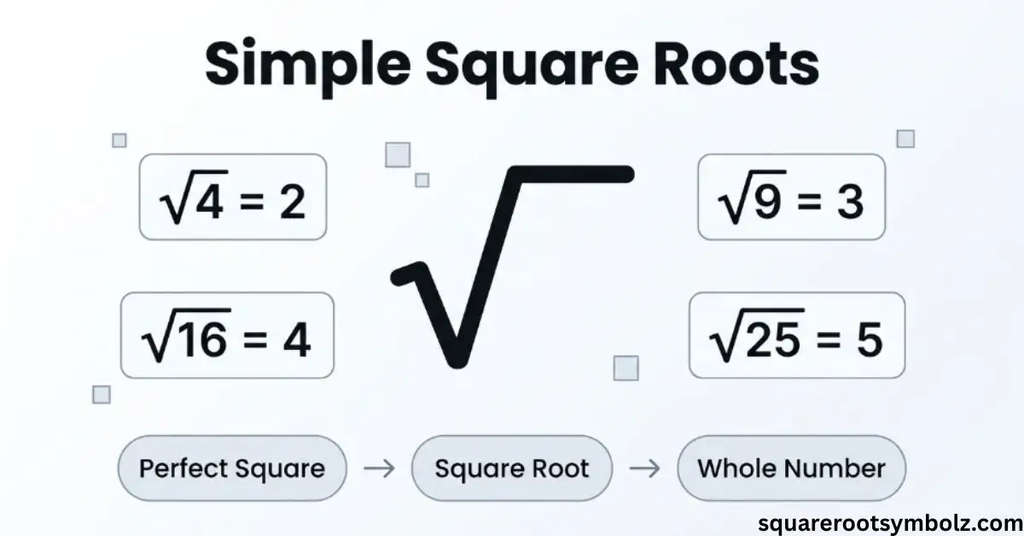
Simple square roots are numbers that can usually be found by asking one question: what number multiplied by itself gives the original number? For example, √25 = 5 because 5 × 5 = 25. This makes square roots the reverse of squaring, a relationship that becomes much easier once you recognize common perfect squares, whole numbers, and multiplication patterns. After years of explaining basic mathematics, I have found that students often struggle not because square roots are difficult, but because the connection between a square number and its square root is not made clear. This guide makes that connection simple.
If you’re staring at √36 and wondering where to begin, start with multiplication facts. Think about 6 × 6 = 36, so the answer is 6. The same idea works for √9, √16, √49, and √100. Once you know the common perfect squares, finding simple square roots becomes almost automatic. You’ll also learn how to handle numbers that are not perfect squares, how to estimate answers, and how square roots appear in equations.
What is the Square Root of a Number?
The square root of a number is the value that, when multiplied by itself, produces that number. For example, 5 × 5 = 25, so √25 = 5. In this relationship, 25 is the perfect square, while 5 is its square root. Square roots therefore reverse the process of squaring.
Think of squaring as moving forward and taking a square root as moving backward. If 8² = 64, then √64 = 8. This simple relationship is the foundation for square numbers, perfect squares, and many later algebra problems. Once this pattern becomes familiar, simple square roots require very little calculation.
A useful beginner table is:
| Squared Number | Multiplication | Square Root |
| 1 | 1 × 1 | 1 |
| 4 | 2 × 2 | 2 |
| 9 | 3 × 3 | 3 |
| 16 | 4 × 4 | 4 |
| 25 | 5 × 5 | 5 |
| 36 | 6 × 6 | 6 |
| 49 | 7 × 7 | 7 |
| 64 | 8 × 8 | 8 |
| 81 | 9 × 9 | 9 |
| 100 | 10 × 10 | 10 |
One detail is important: the symbol √ represents the principal, or nonnegative, square root. Thus √25 = 5. But if you’re solving an equation such as x² = 25, there are two solutions: x = 5 and x = −5.
How to find the Square Root of a Number
For a perfect square, finding a square root is simply a matter of identifying the number that was multiplied by itself. To calculate √81, ask, “What number times itself equals 81?” Since 9 × 9 = 81, the answer is √81 = 9. This approach is especially useful for simple square roots.
Start by remembering common squares from 1² through 12². For example, 7² = 49, 8² = 64, 9² = 81, 10² = 100, 11² = 121, and 12² = 144. When you see one of these numbers underneath a radical symbol, you can immediately identify its square root.
Using a Calculator
A calculator provides a quick way to find square roots, particularly when the number is not a perfect square. Enter the number and use the √ function. For example, √50 is approximately 7.071. A calculator is useful for checking work, but understanding perfect squares first makes the result easier to judge.
Guess and Check Method
Guess and check works well with small numbers. Suppose you need √36. Think of a number near 6, then multiply it by itself. Because 6 × 6 = 36, your guess is correct. For larger numbers, compare nearby perfect squares first, then refine the estimate if the answer is not an integer.
How to Find Square Root without a Calculator
You can find many simple square roots mentally by memorizing perfect squares. For example, if you remember that 12² = 144, then √144 = 12. This is why multiplication tables are so helpful when learning square roots. The EdPlace approach similarly connects square roots directly with knowing which number was multiplied by itself.
For a number such as √20, there is no whole-number answer. Instead, locate the nearest perfect squares: 16 and 25. Because 20 lies between them, √20 must lie between 4 and 5. A calculator gives approximately 4.472, but the perfect-square comparison already tells you the important range.
Long Division Method
The long division method can find square roots when the answer is not immediately recognizable. It separates digits into pairs and progressively determines each digit of the root. Although it is more advanced than memorizing perfect squares, it provides a systematic method for calculating roots without a calculator.
Factorisation Method
Factorization breaks a number into factors and looks for matching pairs. For √36, you can write 36 = 6 × 6, giving √36 = 6. For larger numbers such as 72, factorization reveals 72 = 36 × 2, so √72 = √36 × √2 = 6√2.
3 Simple Square Roots Examples
The easiest way to understand simple square roots is to see the multiplication behind each answer. If the number underneath the radical is a perfect square, its square root is a whole number. If it is not, the result may be irrational and require estimation or a decimal approximation.
Example 1: √9
Ask which number multiplied by itself equals 9.
3 × 3 = 9
Therefore:
√9 = 3
Here, 9 is a perfect square because its square root is an integer.
Example 2: √64
Ask which number multiplied by itself equals 64.
8 × 8 = 64
Therefore:
√64 = 8
This is another straightforward perfect-square example.
Example 3: √100
Ask which number multiplied by itself equals 100.
10 × 10 = 100
Therefore:
√100 = 10
These examples show the main pattern: squaring produces the number; taking the square root reverses that process.
Square Roots 1 to 100
Knowing square roots from 1 to 100 is one of the fastest ways to become comfortable with basic radical problems. Only ten numbers between 1 and 100 are perfect squares: 1, 4, 9, 16, 25, 36, 49, 64, 81, and 100.
| Number | Square Root |
| 1 | 1 |
| 4 | 2 |
| 9 | 3 |
| 16 | 4 |
| 25 | 5 |
| 36 | 6 |
| 49 | 7 |
| 64 | 8 |
| 81 | 9 |
| 100 | 10 |
Everything else from 1 to 100 is a non-perfect square. For instance, √2 ≈ 1.414, √10 ≈ 3.162, and √50 ≈ 7.071. These values do not end in a simple whole number.
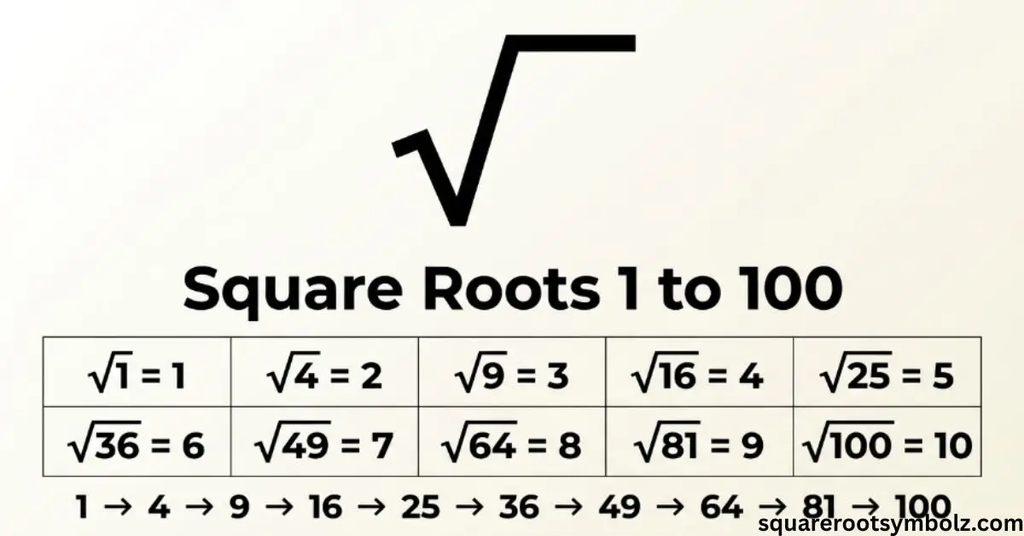
A helpful memory trick is to learn the sequence:
1², 2², 3², 4², 5², 6², 7², 8², 9², 10²
which gives:
1, 4, 9, 16, 25, 36, 49, 64, 81, 100.
Mathcation likewise provides a 1-to-100 square-root table, making it useful for students who want to compare perfect and non-perfect square roots.
Square Roots Definition
A square root is a number that produces the original number when multiplied by itself. In symbols, if a² = b, then √b = a when referring to the principal square root. For example, because 7² = 49, √49 = 7.
The word “square” comes from the idea of multiplying a number by itself. A square with side length 7 has an area of 49 square units. If you know the area is 49, taking √49 lets you work backward to find the side length.
This connection is why square roots appear in geometry, distance calculations, algebra, and other areas of mathematics. The operation is not simply a calculator function; it reverses squaring and helps recover an unknown length or value.
For positive numbers, the principal square root is nonnegative. The equation x² = 49, however, has two solutions:
x = 7 or x = −7
because both 7² and (−7)² equal 49.
Square Roots Formula
The basic square root relationship can be written as:
√x = y
when:
y² = x
Here, x is the number under the radical, commonly called the radicand, and y is its principal square root. For example:
√25 = 5
because:
5² = 25
There is also an important multiplication property:
√a × √b = √(ab)
for nonnegative real numbers. For example:
√4 × √9 = √36 = 6
because √4 = 2 and √9 = 3, giving 2 × 3 = 6.
When simplifying a radical, look for a perfect-square factor. For example:
√72 = √(36 × 2)
= √36 × √2
= 6√2
This method is especially useful when a number is not itself a perfect square but contains one as a factor.
Square Roots in Equations
Square roots become especially important when solving equations. Suppose:
x² = 36
Taking the square root of both sides gives:
x = ±√36
Therefore:
x = ±6
The ± matters because both 6² and (−6)² equal 36. This is different from simply evaluating √36, where the principal square root is 6.
Square roots also appear in quadratic equations. For example:
(x − 2)² = 25
Take the square root of both sides:
x − 2 = ±5
Now solve each possibility:
x = 7
or
x = −3
When equations involve more complicated radicals, simply squaring both sides can sometimes introduce an extraneous solution. That is why checking the final answers in the original equation is an important mathematical habit.
Types of Square Roots
Square roots can be understood through the type of number produced. A perfect square has an integer square root, while a non-perfect square generally produces an irrational value. Square roots of negative numbers require the complex number system rather than the real-number system.
| Type | Example | Result |
| Rational | √25 | 5 |
| Irrational | √2 | 1.414… |
| Complex | √−9 | 3i |
Understanding these categories prevents a common mistake: assuming every square root must be a whole number.
Rational Square Roots
A rational square root can be expressed as a fraction. The simplest examples come from perfect squares such as √4 = 2, √9 = 3, and √25 = 5. These are especially useful when first learning simple square roots because the answers are exact integers.
Irrational Square Roots
An irrational square root cannot be written as a ratio of two integers. Examples include √2, √3, and √5. Their decimal expansions continue indefinitely without repeating. For practical work, these values are often represented using the radical itself or rounded to a chosen decimal place.
Complex Square Roots
The square root of a negative number is not a real number. Instead, complex numbers use i, where i² = −1. Therefore, √−9 = 3i. Complex square roots become important in higher mathematics, although beginners usually focus first on nonnegative real numbers.
Find Simple Square Roots of Numbers
Simple square roots become much easier when you connect them to multiplication. EdPlace’s beginner exercise uses exactly this approach: identify a square number, determine which number was multiplied by itself, and use that number as the square root. For example, because 6 × 6 = 36, √36 = 6.
Try these:
| Problem | Think | Answer |
| √16 | 4 × 4 = 16 | 4 |
| √25 | 5 × 5 = 25 | 5 |
| √36 | 6 × 6 = 36 | 6 |
| √49 | 7 × 7 = 49 | 7 |
| √64 | 8 × 8 = 64 | 8 |
| √81 | 9 × 9 = 81 | 9 |
| √100 | 10 × 10 = 100 | 10 |
Quick Practice
Find each square root:
- √4 = ?
- √9 = ?
- √16 = ?
- √25 = ?
- √36 = ?
- √49 = ?
- √64 = ?
- √81 = ?
- √100 = ?
Answers: 2, 3, 4, 5, 6, 7, 8, 9, and 10.
This type of practice is useful because it trains recognition rather than forcing you to calculate every problem from scratch. Dedicated worksheet resources also use whole-number square-root problems specifically for this beginner stage.
Conclusion
Simple square roots are much easier when you see them as the reverse of squaring. If 6 × 6 = 36, then √36 = 6. Start by memorizing common perfect squares, especially those from 1² through 10², then use estimation or factorization when the number is not a perfect square. With that foundation, radicals, square-root equations, and more advanced algebra become far less intimidating.
The key habit is simple: ask what number multiplied by itself gives the number under the radical. Once that question becomes automatic, simple square roots stop feeling like a separate topic and become a natural part of your number skills.
FAQ Section
What is a simple square root?
A simple square root is usually a square root that can be found easily from a known perfect square. For example, √49 = 7 because 7 × 7 = 49.
What are the easiest square roots to memorize?
Start with √1 through √100 for the perfect squares: 1, 4, 9, 16, 25, 36, 49, 64, 81, and 100.
What is the square root of 25?
The square root of 25 is 5, because 5 × 5 = 25.
What is the square root of 36?
√36 = 6, because 6 × 6 = 36.
What is the square root of 100?
√100 = 10, because 10 × 10 = 100.
How do you find a square root without a calculator?
For a perfect square, identify the number that was multiplied by itself. For a non-perfect square, find the two closest perfect squares and use them to estimate the answer.
What is a perfect square?
A perfect square is a number produced by multiplying an integer by itself. Examples include 1, 4, 9, 16, 25, and 36.
Are all square roots whole numbers?
No. Perfect squares have whole-number square roots, but numbers such as 2, 3, and 10 have irrational square roots.
What is the difference between √25 and x² = 25?
√25 means the principal square root, so the answer is 5. The equation x² = 25 has two solutions: x = 5 and x = −5.
Can a square root be negative?
The principal square root symbol √ represents a nonnegative value. However, an equation such as x² = 25 can have both positive and negative solutions.
What is √2?
√2 is an irrational number, approximately 1.41421356. It cannot be expressed exactly as a fraction of two integers.

I’m the creator of SquareRootSymbolz.com, where I publish easy-to-understand guides on symbols, Unicode characters, Alt codes, keyboard shortcuts, and copy-and-paste text symbols. My goal is to provide accurate, well-researched, and user-friendly content that helps readers quickly find the information they need.