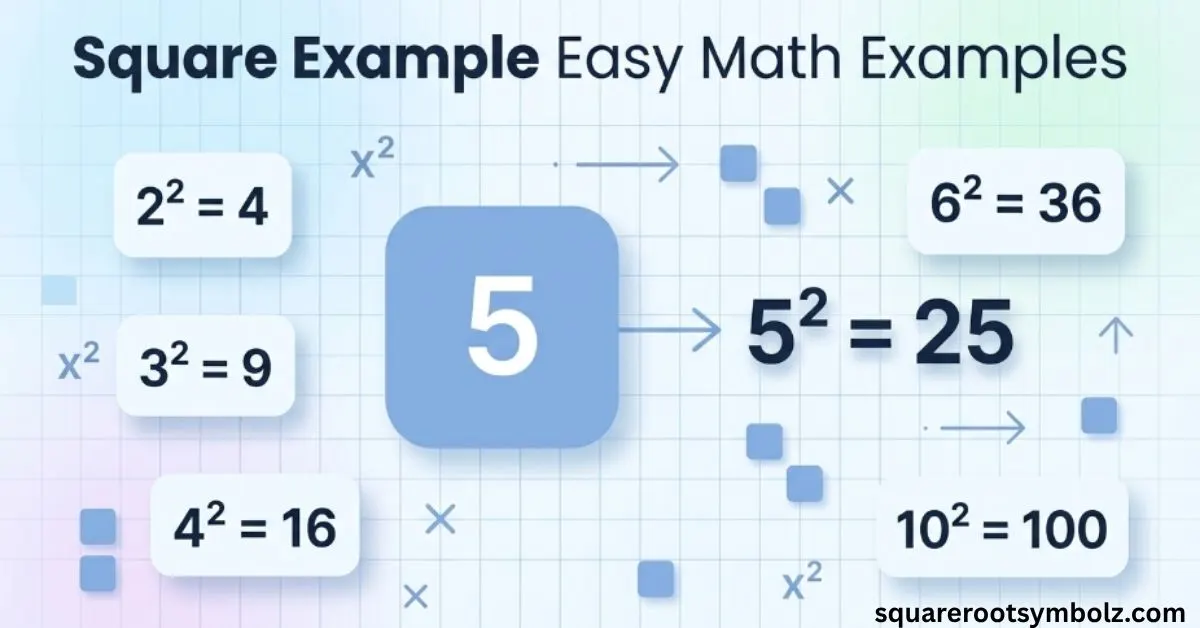
A square example in math usually shows what happens when a number is multiplied by itself. For example, 5 × 5 = 25, so 25 is a square number and 5² is read as “five squared.” As someone who has explained basic math concepts for years, I have seen that the biggest confusion is usually between squaring, square roots, exponents, and the geometric shape called a square.
This guide makes the idea simple. You will see square examples, perfect squares, common square numbers, exponential notation, and real-world uses. Whether you are trying to understand 2², identify a perfect square, or remember why the small ² symbol matters, the examples below give you a clear way to understand the concept.
What Is a Square Number?
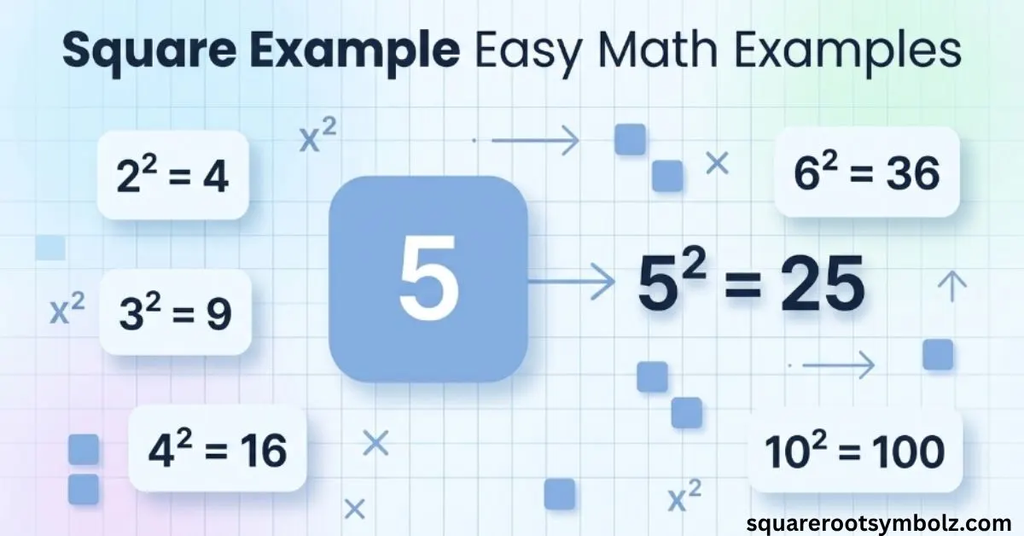
A square number is the result of multiplying a number by itself. In mathematical notation, the number being multiplied is called the base, while the small raised 2 is called the exponent. The expression 7², for example, means 7 × 7, which equals 49.
A simple square example is 4² = 16. This means that 4 has been multiplied by itself once. Square numbers are closely connected with perfect squares, integers, and square roots, making them an important part of arithmetic, algebra, and geometry.
The word “square” has a geometric connection too. If a square shape has a side length of 6, its area is 6 × 6 = 36 square units. This visual relationship helps explain why multiplying a number by itself is called squaring.
| Number | Multiplication | Exponential Form | Square |
| 1 | 1 × 1 | 1² | 1 |
| 2 | 2 × 2 | 2² | 4 |
| 3 | 3 × 3 | 3² | 9 |
| 4 | 4 × 4 | 4² | 16 |
| 5 | 5 × 5 | 5² | 25 |
| 6 | 6 × 6 | 6² | 36 |
Examples of Square Numbers
The easiest way to understand a square example is to start with small numbers. When you multiply 2 by 2, you get 4. When you multiply 3 by 3, you get 9. Each answer is called a square number.
Here are several simple examples:
- 1² = 1 × 1 = 1
- 2² = 2 × 2 = 4
- 3² = 3 × 3 = 9
- 4² = 4 × 4 = 16
- 5² = 5 × 5 = 25
- 10² = 10 × 10 = 100
A square example does not always have to involve a small number. For instance, 12² = 144, while 25² = 625. The rule never changes: multiply the original number by itself.
Negative numbers can also be squared. For example:
(−4)² = (−4) × (−4) = 16
The result is positive because multiplying two negative numbers gives a positive result. This is one reason students must pay attention to parentheses when working with negative values.
List of Square Numbers
A list of square numbers is useful because many common squares appear repeatedly in algebra, geometry, and square-root problems. Memorizing smaller perfect squares can make mental calculations much faster.
Here are some of the most common square numbers:
| Number | Square |
| 1 | 1 |
| 2 | 4 |
| 3 | 9 |
| 4 | 16 |
| 5 | 25 |
| 6 | 36 |
| 7 | 49 |
| 8 | 64 |
| 9 | 81 |
| 10 | 100 |
| 11 | 121 |
| 12 | 144 |
| 13 | 169 |
| 14 | 196 |
| 15 | 225 |
| 20 | 400 |
These values are called perfect squares because each one is the square of an integer. For example, 144 is a perfect square because 12 × 12 = 144. Its principal square root is therefore √144 = 12.
Learning the squares from 1² through at least 15² is especially helpful. These numbers appear in the Pythagorean theorem, area calculations, quadratic equations, and square-root exercises.
Two Digit Square Numbers
A two-digit square number is a perfect square between 10 and 99. These values are important because they often appear in basic multiplication, factorization, and square-root questions.
The two-digit perfect squares are:
16, 25, 36, 49, 64, and 81
For example, 49 is a square number because:
7 × 7 = 49
Likewise, 81 is the square of 9 because:
9 × 9 = 81
A quick way to check whether a number is a perfect square is to think about its square root. If the square root is an integer, the number is a perfect square. For example, √64 = 8, so 64 is a square number.
Square Numbers Examples
Consider the question: What is the square of 8?
Multiply the number by itself:
8 × 8 = 64
Therefore:
8² = 64
Here is another square example. Find the square of 15:
15 × 15 = 225
Therefore:
15² = 225
The exponent notation makes repeated multiplication easier to read. Instead of writing 15 × 15, mathematicians write 15². The exponent 2 immediately tells you that the base is being multiplied by itself.
Example: Is 49 a Square Number?
To check whether 49 is a square number, look for an integer that produces 49 when multiplied by itself:
7 × 7 = 49
Therefore, 49 is a perfect square.
Its square root is:
√49 = 7
This creates an important relationship: squaring and finding a square root are inverse operations.
Example: Find the Square of 25
To find the square of 25, multiply:
25 × 25 = 625
Therefore:
25² = 625
The answer 625 is also a perfect square because it is the product of an integer multiplied by itself.
Sum of Square Numbers
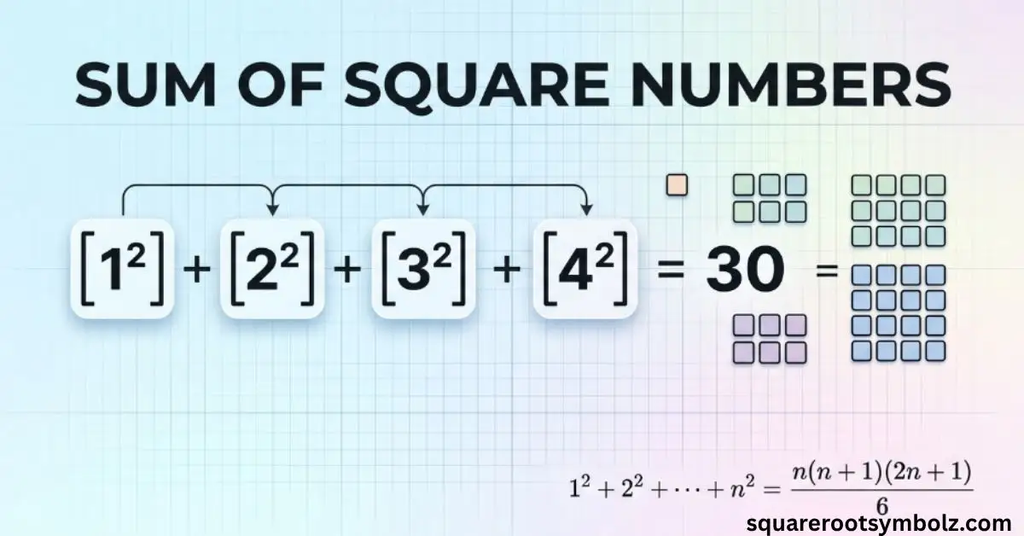
Sometimes a math problem asks you to add several square numbers together. For example, find the sum of the squares of 3 and 4.
First, find each square:
3² = 9
4² = 16
Now add them:
9 + 16 = 25
Therefore:
3² + 4² = 25
This type of square example appears in many areas of mathematics. One famous formula is the Pythagorean theorem:
a² + b² = c²
For a right triangle with sides 3 and 4:
3² + 4² = 9 + 16 = 25
Since:
c² = 25
the missing side is:
c = 5
Square numbers therefore connect simple multiplication with geometry, algebra, distance calculations, and many scientific formulas.
Conclusion
A square example is one of the easiest ways to understand how squaring works in mathematics. The rule is simple: multiply a number by itself. So 4² = 16, 7² = 49, and 10² = 100. The small exponent 2 tells you that the base is being squared.
Once you recognize common perfect squares, many other concepts become easier. Square roots, quadratic equations, geometric area, and formulas such as the Pythagorean theorem all depend on the same basic idea. Start with small examples, practice the common square numbers, and the meaning of “squared” quickly becomes second nature.
FAQs
What is a square example in math?
A square example shows a number multiplied by itself. For instance, 6 × 6 = 36, so 36 is the square of 6, written as 6².
What are examples of square numbers?
Common examples include 1, 4, 9, 16, 25, 36, 49, 64, 81, and 100. Each is created by multiplying an integer by itself.
What does 5 squared mean?
Five squared means 5 × 5. Therefore, 5² = 25.
Is 49 a square number?
Yes. 49 is a square number because 7 × 7 = 49. It is also a perfect square because its square root, √49, is an integer.
What is the square of 100?
The square of 100 is 10,000 because 100 × 100 = 10,000.
Is 0 a square number?
Yes. Zero is a square number because 0 × 0 = 0, so 0² = 0.
Can a negative number be squared?
Yes. A negative number can be squared. For example, (−6)² = 36 because multiplying two negative numbers produces a positive result.
What is the difference between a square and a square root?
A square is found by multiplying a number by itself, while a square root reverses that operation. For example, 8² = 64, while √64 = 8.

I’m the creator of SquareRootSymbolz.com, where I publish easy-to-understand guides on symbols, Unicode characters, Alt codes, keyboard shortcuts, and copy-and-paste text symbols. My goal is to provide accurate, well-researched, and user-friendly content that helps readers quickly find the information they need.