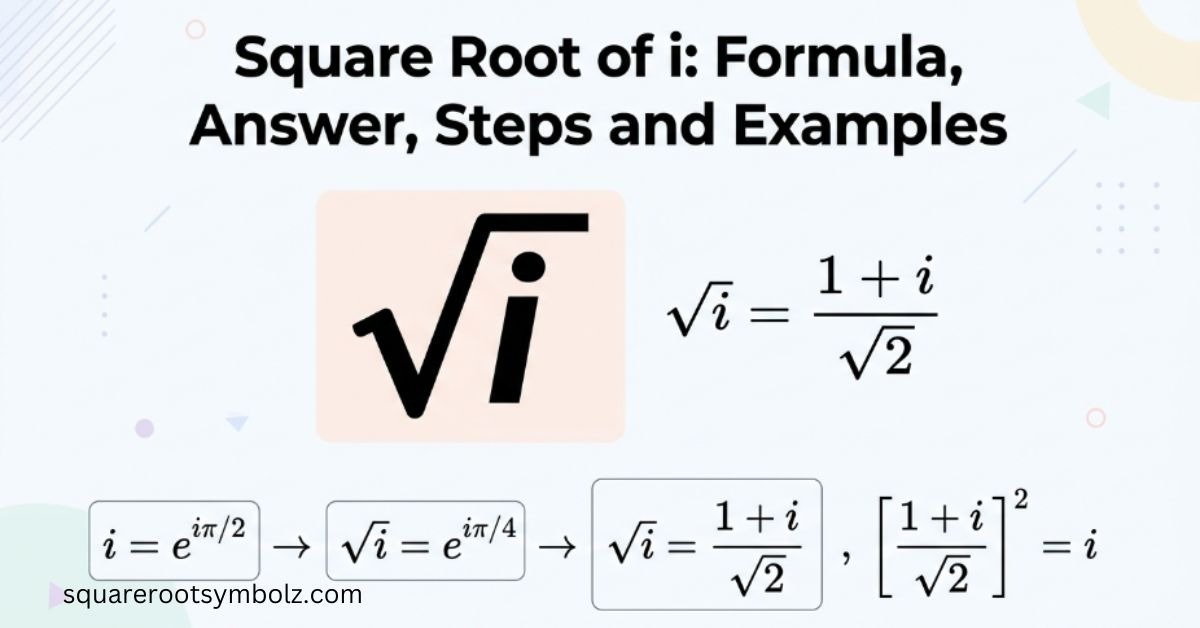
The square root of i is 21+i for the principal square root, while the equation z2=i has two solutions: ±21+i. If this feels confusing, you are not alone. Complex numbers, imaginary units, radicals, and principal values can make a simple-looking problem feel much harder than it is.
After working through complex-number problems, I have found that the easiest approach is to stop treating i like an ordinary real number. Instead, use rectangular form, polar form, or direct verification. Once you see that taking a square root halves an angle on the complex plane, the answer becomes much easier to understand.
What is the Square Root of i?
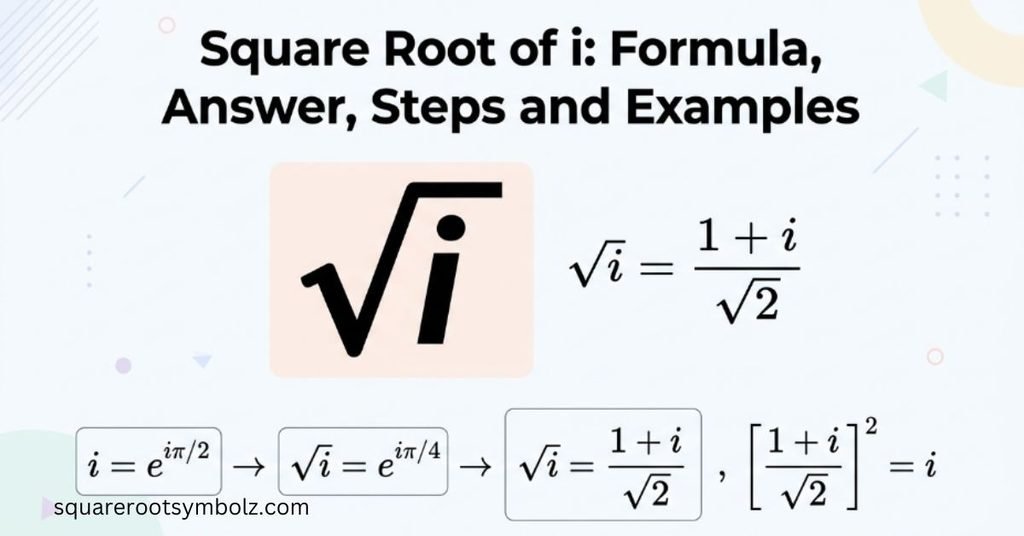
The principal square root of i is:
i=21+i
An equivalent form is:
i=22+22i
This is the principal square root, meaning one particular value has been selected according to the standard principal-value convention used for complex functions.
However, if you ask for all numbers whose square equals i, there are two answers:
±21+i
So the two square roots are:
21+i
and
−21+i
The second root can also be written as:
−21−2i
Both values produce i when squared. This distinction between a principal square root and both solutions of an equation is important in complex mathematics.
Square Root of i Formula
A useful answer to remember is:
i=21+i
for the principal value.
For both square roots:
z=±21+i
You can also express the principal root in exponential form:
i=eiπ/4
Since i has modulus 1 and principal argument π/2, taking its square root keeps the modulus as 1 and halves the argument to π/4.
| Form | Square Root of i |
| Rectangular form | 21+2i |
| Radical form | 21+i |
| Polar form | cos(π/4)+isin(π/4) |
| Exponential form | eiπ/4 |
| Both roots | ±21+i |
How to Find the Square Root of i Using a+bi
Let the unknown complex number be:
z=a+bi
We want:
z2=i
Squaring a+bi gives:
(a+bi)2=a2+2abi+b2i2
Because:
i2=−1
we get:
(a+bi)2=a2−b2+2abi
Since this must equal:
i=0+1i
we compare the real and imaginary parts.
Therefore:
a2−b2=0
and:
2ab=1
The first equation means:
a2=b2
For this particular system, the valid solution requires a=b. Then:
2a2=1
So:
a2=21
Therefore:
a=±21
and b has the same sign.
The two answers are:
21+i
and
−21+i
This direct algebraic approach is the same core method used in standard explanations of the problem.
Square Root of i Using Polar Form
The polar method is often the fastest once you understand complex numbers geometrically.
The number i lies on the positive imaginary axis. Its distance from the origin is 1, and its principal angle is:
2π
Therefore:
i=cos(2π)+isin(2π)
Taking the square root halves the angle:
2π/2=4π
So one square root is:
cos(4π)+isin(4π)
Since:
cos(4π)=sin(4π)=22
we get:
i=22+22i
The other root lies 180∘ away on the complex plane:
−22−22i
This geometric method explains an important idea: taking the square root of a complex number involves halving its argument.
Why Does the Square Root of i Have Two Answers?
Every nonzero complex number has two square roots.
If:
z2=i
then:
(−z)2=z2=i
This happens because changing the sign disappears when a number is squared.
For example:
(21+i)2=i
But also:
(−21+i)2=i
Therefore both are valid solutions.
The same pattern appears with real numbers. For example, the equation:
x2=9
has:
x=3
and:
x=−3
But the radical symbol:
9
normally means the principal nonnegative root:
3
Complex-number notation follows a similar idea. The equation has two roots, while i can represent a chosen principal value.
Is the Square Root of i an Imaginary Number?
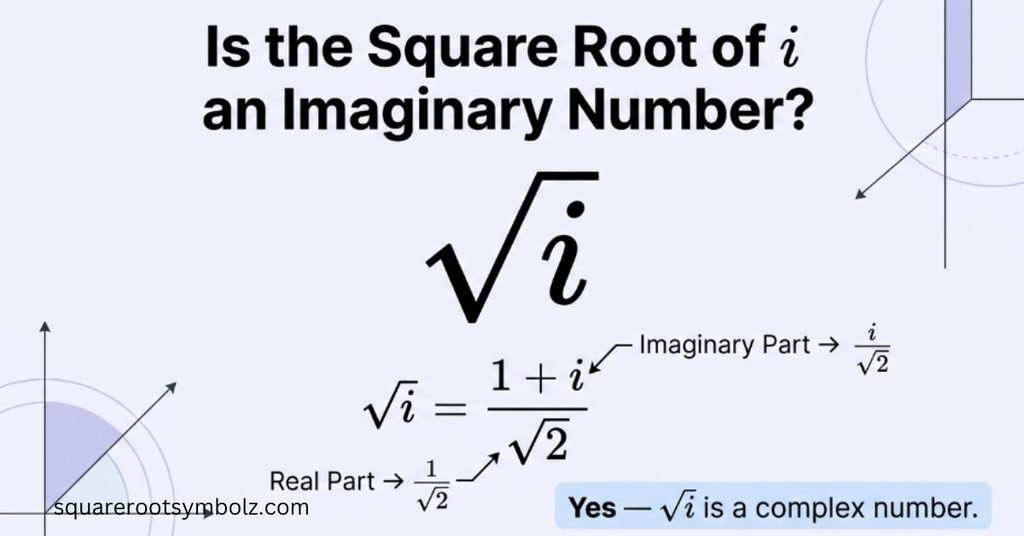
Not in the strict sense of a pure imaginary number.
A pure imaginary number has the form:
bi
where its real part is zero.
But:
i=21+21i
has both:
- a real part: 21
- an imaginary part: 21
Therefore, the square root of i is a complex number, not a purely imaginary number.
This is a common point of confusion because i itself is imaginary. But taking a square root can move the result to another location on the complex plane.
How to Verify the Answer
Take:
z=21+i
Now square it:
z2=(21+i)2
This becomes:
z2=2(1+i)2
Expand:
(1+i)2=1+2i+i2
Since:
i2=−1
we get:
1+2i−1=2i
Therefore:
z2=22i
So:
z2=i
That verifies that:
21+i
is indeed a square root of i. The negative version also works because squaring removes the negative sign.
Square Root of i on the Complex Plane
The complex number i sits at:
(0,1)
on the complex plane.
The principal square root sits at:
(21,21)
This point lies at an angle of:
45∘
or:
4π
from the positive real axis.
The second root is the opposite point:
(−21,−21)
at:
225∘
or:
45π
Both points are equally important when solving the equation z2=i. The principal value simply selects the root associated with the principal argument.
Common Mistakes When Finding i
The first common mistake is assuming:
i=i
This cannot be correct because:
i2=−1
not i.
Another mistake is writing:
i=1+i
But:
(1+i)2=2i
The answer is close, but it must be divided by 2:
21+i
A third mistake is forgetting the second root. The equation:
z2=i
has two solutions:
±21+i
Finally, some learners call the answer purely imaginary. It is actually a complex number because both its real and imaginary components are nonzero.
Square Root of i Example
Example
Find all solutions of:
x2=i
Step 1: Write the known formula
x=±21+i
Step 2: Write both answers
x1=21+i
and:
x2=−21+i
Step 3: Verify
For the first root:
(21+i)2=i
For the second root:
(−21+i)2=i
Therefore:
x=±21+i
Principal Square Root vs Both Square Roots
This distinction is worth remembering.
| Situation | Answer |
| Principal i | 21+i |
| Solve z2=i | ±21+i |
| Polar angle of principal root | π/4 |
| Modulus of each root | 1 |
| Number of square roots | 2 |
In everyday algebra, people sometimes say “the square root” when they mean all possible roots. In complex analysis, however, the principal square-root convention becomes especially important because functions need a consistent selected value.
FAQ Section
What is the square root of i?
The principal square root is:
i=21+i
The equation z2=i has two solutions: ±21+i.
Is i equal to i?
No. If i=i, then squaring would give i2=−1, not i.
Why does the square root of i contain both 1 and i?
Because a number of the form a+bi must have both real and imaginary components that work together so that its square equals i.
Is the square root of i imaginary?
It is a complex number, not a pure imaginary number, because 21+i has both a real and imaginary part.
What are the two square roots of i?
They are:
21+i
and:
−21+i
How do you find i using polar form?
Write i with argument π/2, halve the angle to π/4, and keep the modulus at 1. This gives eiπ/4, which equals 21+i.

I’m the creator of SquareRootSymbolz.com, where I publish easy-to-understand guides on symbols, Unicode characters, Alt codes, keyboard shortcuts, and copy-and-paste text symbols. My goal is to provide accurate, well-researched, and user-friendly content that helps readers quickly find the information they need.