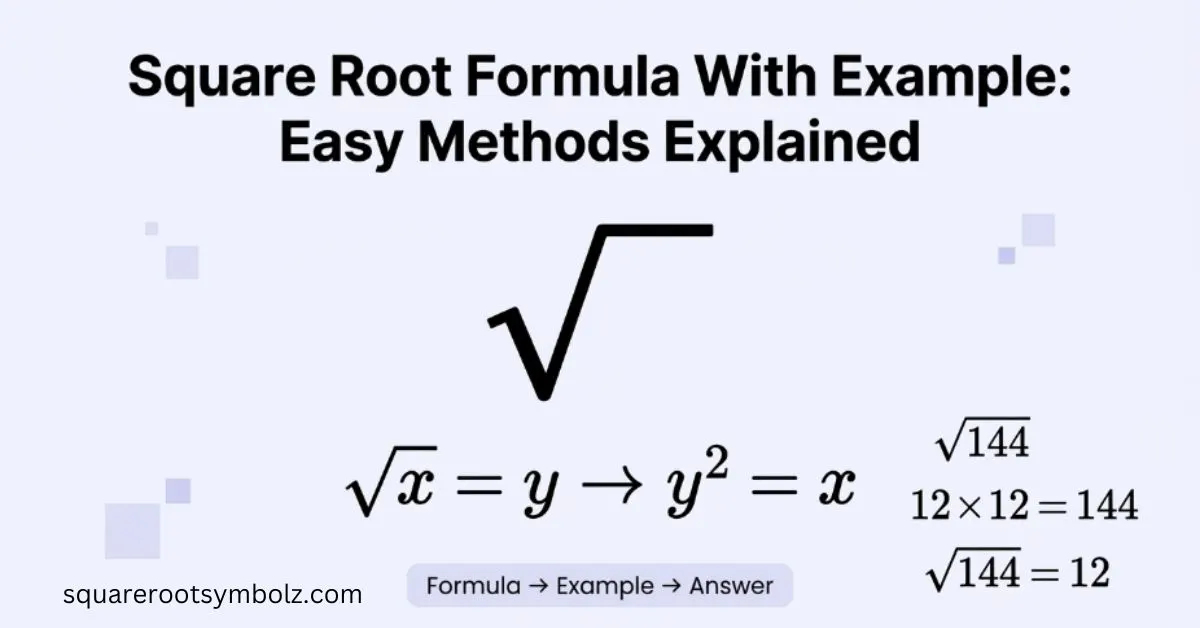
The square root formula with example is simple: the square root of a number is a value that produces the original number when multiplied by itself. In more formal terms, √x = x¹ᐟ². After years of explaining math concepts through beginner-friendly examples, I have found that understanding the relationship between squares, exponents, perfect squares, radicals, and multiplication makes this topic much easier.
Many students can memorize a formula but still feel stuck when they see √144, √60, or a larger number. The solution is to understand what the radical symbol, principal square root, exponent, prime factorization, and long division method are actually doing. This guide explains the formula, the methods behind it, and several step-by-step examples.
What Is the Square Root Formula?
A square root is the value that gives the original number when multiplied by itself. For example, 5 × 5 = 25, so 5 is the square root of 25. The square root formula is closely connected with perfect squares, multiplication, exponents, real numbers, and radical expressions.
The basic idea is that finding a square root reverses the process of squaring. If a number is squared first, a square root can bring us back to its original value. This inverse relationship is why square roots appear so often in algebra, geometry, equations, measurements, and scientific calculations.
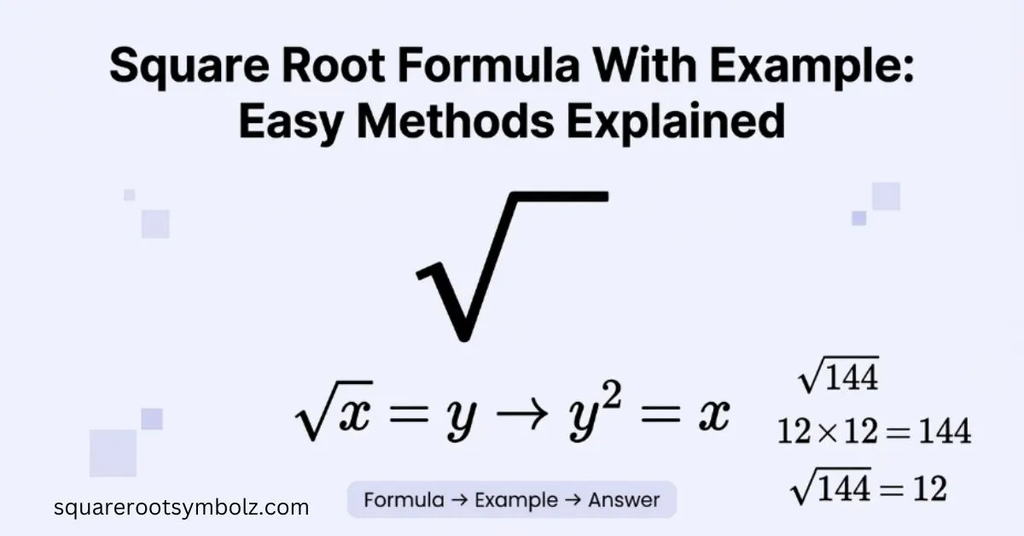
Key Formula for Square Root With Example
The basic formula is:
√x = x¹ᐟ²
This means the square root of x is the same as raising x to the power of one-half. The radical symbol, exponent, base, power, and square root notation all describe the same mathematical relationship in different forms.
For example:
√81 = 81¹ᐟ² = 9
Why? Because:
9 × 9 = 81
So, the principal square root of 81 is 9. This is also why 81 is called a perfect square.
Important Difference Between √81 and x² = 81
This is where many students get confused.
When you write:
√81 = 9
the symbol √ means the principal square root, which is non-negative.
But when solving:
x² = 81
there are two solutions:
x = 9 or x = −9
Both work because:
9² = 81
(−9)² = 81
Understanding this difference prevents one of the most common square-root mistakes.
Popular Methods to Find the Square Root Formula With Example
There is no single method that works best for every number. Perfect squares, non-perfect squares, prime factors, estimation, and long division each require a slightly different approach.
The easiest choice depends on the number in front of you. If the number is small and familiar, mental calculation may be enough. If it has clear factor pairs, prime factorization works well. For large or non-perfect squares, estimation or the long division method can be more useful.
| Method | Best Used For | Example |
| Mental calculation | Small perfect squares | √49 = 7 |
| Prime factorization | Numbers with useful prime pairs | √144 = 12 |
| Exponential form | Expressions with powers | √x = x¹ᐟ² |
| Estimation | Non-perfect squares | √20 ≈ 4.47 |
| Long division | Larger numbers | √8281 = 91 |
A good math habit is to identify the type of number before choosing a method. This saves time and helps you avoid turning a simple problem into a complicated calculation.
How to Find the Square Root of a Number in Exponential Form
The square root formula with example can also be understood through exponents. Taking the square root of a number means raising that number to the power of 1/2. This connects radicals, powers, exponents, bases, and algebraic expressions.
For example:
√16 = 16¹ᐟ²
Since:
16 = 4²
we get:
(4²)¹ᐟ² = 4
The exponent 2 and the exponent 1/2 cancel through the inverse relationship between squaring and taking a square root.
Another example is:
√x⁶ = x³
because:
(x⁶)¹ᐟ² = x³
This method becomes especially useful when working with algebraic expressions and higher powers.
How to Find the Square Root of a Number by Prime Factorization
Prime factorization is one of the clearest methods for finding the square root of a perfect square. You break the number into prime factors, matching pairs, multiplication groups, and simplified factors.
Let’s find:
√144
First, write the prime factorization:
144 = 2 × 2 × 2 × 2 × 3 × 3
Now create matching pairs:
(2 × 2)(2 × 2)(3 × 3)
Take one number from every pair:
2 × 2 × 3 = 12
Therefore:
√144 = 12
Square Root Formula With Example: √225
Start with prime factorization:
225 = 3 × 3 × 5 × 5
Make pairs:
(3 × 3)(5 × 5)
Take one factor from each pair:
3 × 5 = 15
Therefore:
√225 = 15
Prime factorization is especially useful because every pair inside the radical produces one factor outside it.
How to Find the Square Root of a Number by Long Division
The long division method is useful when a number is large or when its square root is not immediately obvious. It uses digit pairs, subtraction, multiplication, estimation, and repeated steps to gradually identify the correct root.
For example, consider:
√8281
Group the digits from the right:
82 | 81
The largest perfect square not greater than 82 is:
9² = 81
So, the first digit of the square root is 9. Continuing the long-division process gives the second digit, 1.
Therefore:
√8281 = 91
The long division method is slower than recognizing a perfect square, but it is systematic. That makes it useful when mental calculation or prime factorization is difficult.
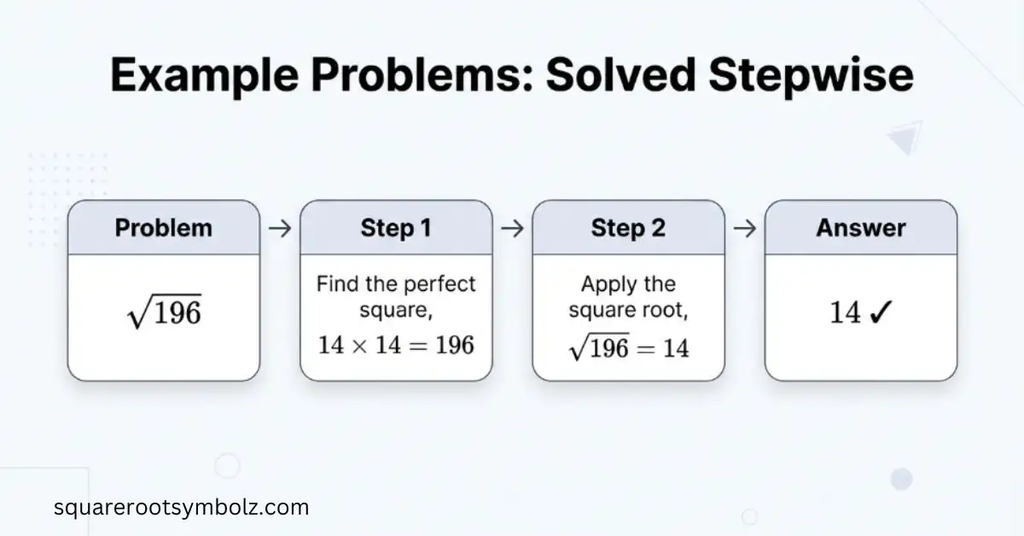
Example Problems: Solved Stepwise
Example 1: Find the Square Root of 400
Use the square root formula:
√400 = ?
We know:
20 × 20 = 400
Therefore:
√400 = 20
This is a simple example of a perfect square.
Example 2: Find the Square Root of 60
First, find a perfect square factor:
60 = 4 × 15
Now:
√60 = √(4 × 15)
Using the product relationship:
√60 = √4 × √15
Since:
√4 = 2
we get:
√60 = 2√15
This example shows how a non-perfect square can often be simplified instead of converted immediately into a decimal.
Example 3: Find the Side of a Square With an Area of 400 Square Units
The area of a square is:
Area = side²
To find the side, reverse the square:
Side = √Area
So:
Side = √400 = 20
Therefore, the side length is:
20 units
This is a practical example of why square roots matter in geometry, measurement, area calculations, and real-world problem solving.
Frequent Errors and Misunderstandings
One common mistake is assuming that every square root is a whole number. Numbers such as 4, 9, 16, and 25 have integer roots, but many numbers do not. For example, √2 and √15 are irrational numbers, meaning their decimal values continue without repeating.
Another mistake is confusing the radical symbol with an equation. √49 = 7, not ±7, because √ indicates the principal square root. However, when solving x² = 49, both x = 7 and x = −7 are valid solutions.
Students also sometimes assume that:
√(a + b) = √a + √b
This is generally false.
For example:
√(9 + 16) = √25 = 5
But:
√9 + √16 = 3 + 4 = 7
So, square roots must be handled according to the actual structure of the expression.
Relation to Other Concepts
The square root formula connects directly with squares, exponents, quadratic equations, algebra, geometry, and irrational numbers. Once you understand square roots, many later mathematical topics become easier.
For example, the area of a square is found by squaring its side length. The reverse operation finds the side from the area. Similarly, the Pythagorean theorem often requires taking a square root after calculating squared side lengths.
Square roots also appear in quadratic equations. The famous quadratic formula contains:
√(b² − 4ac)
The expression inside the radical helps determine the nature of the solutions. This makes square roots an important bridge between basic arithmetic and more advanced algebra.
Conclusion
The square root formula with example becomes much easier when you remember one core idea: a square root reverses squaring. The formula √x = x¹ᐟ² connects radicals and exponents, while methods such as mental calculation, prime factorization, estimation, and long division help you handle different kinds of numbers.
Start with familiar perfect squares, then practice simplified radicals and larger calculations. Once you understand why √144 = 12 and why √60 = 2√15, square roots stop looking like mysterious symbols and become a logical part of everyday mathematics.
FAQs
What is the square root formula in math?
The basic square root formula is √x = x¹ᐟ². It means that taking a square root is the same as raising a number to the power of one-half.
How do you find the square root of a number?
You can use mental calculation, prime factorization, estimation, or the long division method depending on the number.
Why does √25 equal 5 and not −5?
√25 means the principal square root, which is 5. But the equation x² = 25 has two solutions: 5 and −5.
What is an example of the square root formula?
For example, √144 = 144¹ᐟ² = 12 because 12 × 12 = 144.
Can a negative number have a square root?
A negative number does not have a real square root. In complex mathematics, √−1 is represented by i.
What is the easiest way to find a square root?
For small perfect squares, memorization is fastest. For larger perfect squares, prime factorization is useful, while estimation or long division can help with non-perfect squares.

I’m the creator of SquareRootSymbolz.com, where I publish easy-to-understand guides on symbols, Unicode characters, Alt codes, keyboard shortcuts, and copy-and-paste text symbols. My goal is to provide accurate, well-researched, and user-friendly content that helps readers quickly find the information they need.