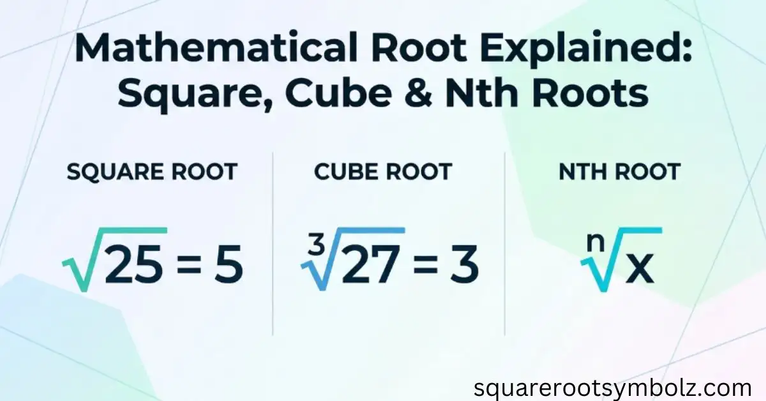
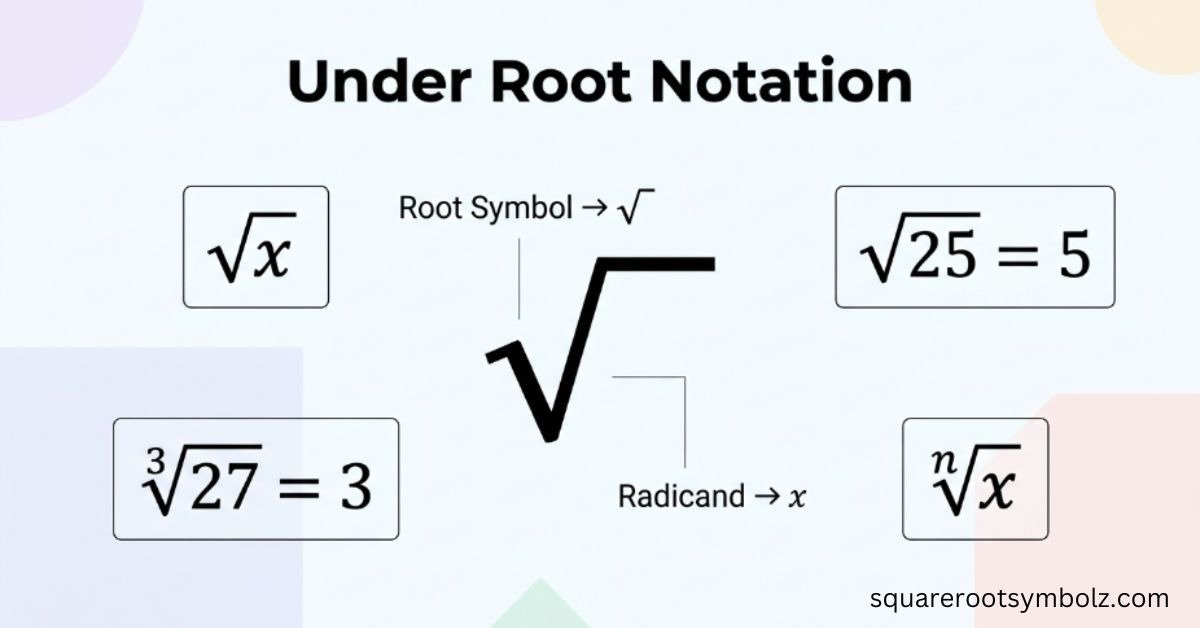
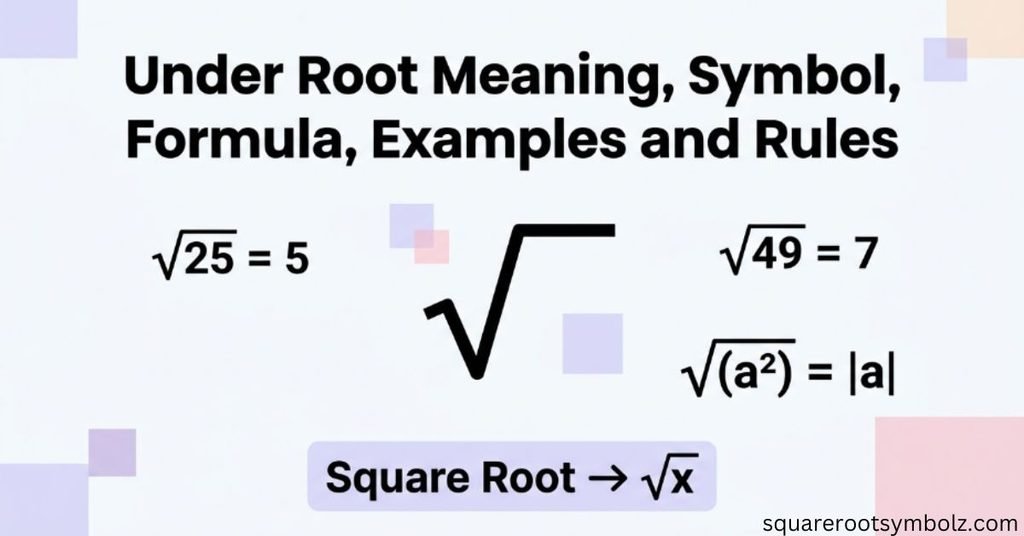
Under root means finding the square root of a number or expression written inside the √ symbol. In mathematics, this process reverses squaring: instead of multiplying a number by itself, you work backward to discover the value that produces the original number. The radical sign, radicand, perfect square, exponent, and principal square root all help explain how the notation works.
Students often understand an expression like √25 but get confused about what is actually “under the root.” After years of explaining square roots in simple mathematical terms, the easiest way to understand it is this: identify the number under the radical sign, then find the value whose square gives that number. This guide covers notation, formulas, examples, and common rules.
Under Root and the Square Root
The phrase under root is commonly used for a number or expression placed inside a square root symbol. For example, in √49, the number 49 is under the root. The entire expression represents the square root operation, which asks which value multiplied by itself gives 49.
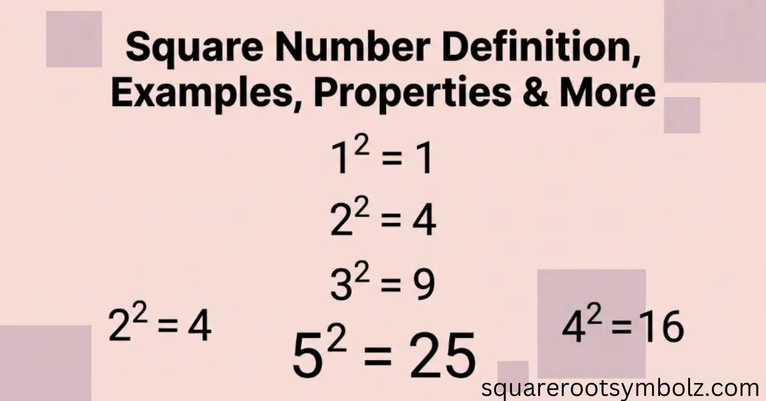
Think of squaring and taking a square root as reverse operations. Since 7 × 7 = 49, we know that √49 = 7. This relationship helps students move naturally between exponents, perfect squares, and radical expressions without treating the √ symbol as a mysterious mathematical sign.
Definition of Under Root
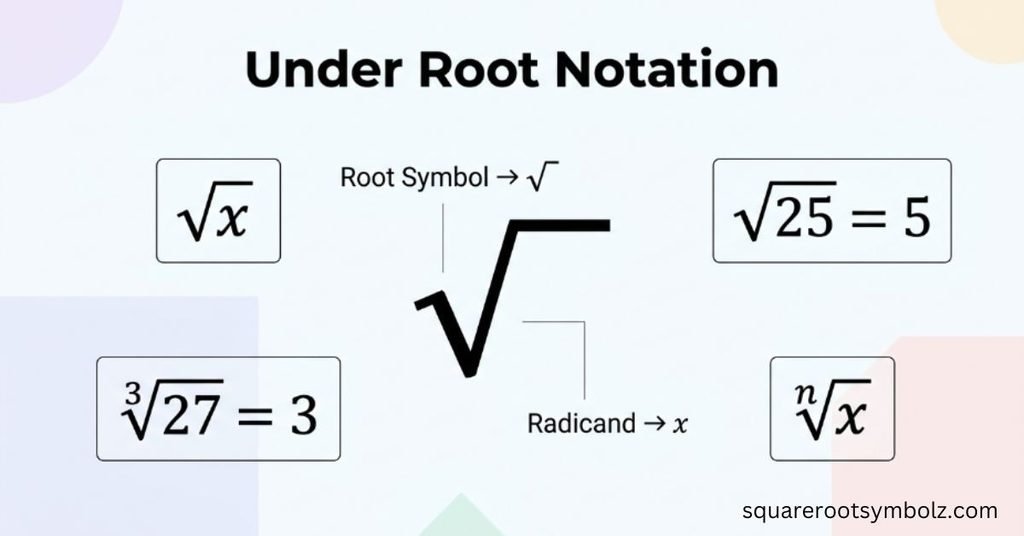
In everyday math language, “under root” refers to the value placed beneath the radical symbol. In formal mathematics, the complete operation is called taking a square root, while the number or expression inside the symbol is called the radicand.
For example:
√16 = 4
Here, 16 is under the root, 16 is the radicand, and 4 is the principal square root. The answer works because multiplying 4 by itself produces 16. Understanding these separate roles makes radical notation much easier to read.
The Under Root Symbol √
The symbol used for an under root expression is √, known as the radical sign. When a number appears beneath this symbol, the sign tells you to find its square root unless another index indicates a different type of root.
For example:
| Expression | Number Under Root | Value |
| √4 | 4 | 2 |
| √9 | 9 | 3 |
| √16 | 16 | 4 |
| √25 | 25 | 5 |
| √81 | 81 | 9 |
The horizontal line extending from the radical sign can cover one number, several numbers, or an entire algebraic expression.
Under Root and Two Square Roots
A positive number actually has two numbers that can square to produce the same result. For example, both 5 × 5 and −5 × −5 equal 25. Therefore, 5 and −5 are both square roots of 25.
However, this does not mean that √25 = ±5. The radical symbol itself represents the principal square root, so √25 = 5. The negative value becomes important when solving equations rather than simply evaluating a radical expression.
Under Root and the Principal Square Root
The principal square root is the non-negative value represented by the √ symbol. This convention gives mathematical notation one clear meaning and prevents the same expression from producing two direct answers.
For example:
√36 = 6
Although −6 is also a square root of 36 because (−6)² = 36, the expression √36 specifically means the principal square root. Zero is also included: √0 = 0, and zero has only one square root.
Under Root and the Plus-Minus Sign
The plus-minus symbol ± becomes important when solving an equation containing a squared variable. For instance, if x² = 25, both 5 and −5 satisfy the equation.
Therefore:
x = ±√25
x = ±5
The ± sign belongs to the solution process, not automatically to every square root expression. This is one of the most common mistakes students make when moving between evaluating √25 and solving x² = 25.
Under Root of a Number
Finding the under root value of a number means identifying the number that produces the radicand when multiplied by itself. Perfect squares are the easiest examples because they have whole-number square roots.
Some common values include:
- √1 = 1
- √4 = 2
- √9 = 3
- √16 = 4
- √25 = 5
- √36 = 6
- √49 = 7
- √64 = 8
- √81 = 9
- √100 = 10
These values are useful because recognizing perfect squares makes algebra and arithmetic much faster.
Under Root Notation
Square root notation uses the radical sign followed by a radicand. The expression √m is read as “the square root of m.” In formal notation, the principal square root of a non-negative number is always non-negative.
For example:
√64 = 8
because:
8² = 64
The radical expression and exponent notation describe the same relationship in different forms. For non-negative values, a square root can also be connected with the exponent 1/2, such as x^(1/2).
Finding Under Root Values
The simplest method is to ask: What number multiplied by itself gives the value under the root? For a perfect square, the answer may be immediately recognizable.
For example:
√64 = ?
Since 8 × 8 = 64, the answer is 8.
For larger values, factorization can help. Breaking a number into prime factors allows matching factors in pairs. Each complete pair contributes one factor outside the radical expression.
Example: Finding √400
Prime factorization gives:
400 = 2 × 2 × 2 × 2 × 5 × 5
Group the factors into pairs:
(2 × 2)(2 × 2)(5 × 5)
Take one value from each pair:
√400 = 2 × 2 × 5 = 20
So the under root value of 400 is 20.
Under Root of xy
When variables or numbers are multiplied inside a radical, square root properties can sometimes help simplify the expression. For suitable non-negative values:
√xy = √x × √y
For example:
√(4 × 9) = √4 × √9
= 2 × 3
= 6
This property is useful in algebra because it can break one complicated radical expression into simpler square roots. Care is needed when extending radical rules to broader real-number expressions.
Common Under Root Examples
| Under Root Expression | Meaning | Answer |
| √4 | Square root of 4 | 2 |
| √9 | Square root of 9 | 3 |
| √16 | Square root of 16 | 4 |
| √49 | Square root of 49 | 7 |
| √100 | Square root of 100 | 10 |
| √121 | Square root of 121 | 11 |
| √144 | Square root of 144 | 12 |
The pattern is simple: if n × n = a, then √a = n when n is the principal, non-negative square root.
Conclusion
Under root simply describes the square root operation and, in everyday usage, the number or expression written beneath the √ radical sign. The key to understanding it is remembering that square roots reverse squaring.
Once you know the difference between the radical sign, radicand, principal square root, and ± sign, most common square root problems become much easier. Start with familiar perfect squares, then use factorization and algebraic rules for more complex expressions.
FAQ Section
What does under root mean in mathematics?
Under root usually refers to a number or expression inside the √ symbol. In formal mathematics, that inside value is called the radicand.
What is the symbol for under root?
The symbol is √, called the radical sign or square root symbol.
What is under root 25?
√25 = 5 because 5 × 5 = 25.
Is √9 equal to 3 or ±3?
√9 = 3 because the radical sign represents the principal non-negative square root. However, the equation x² = 9 has solutions x = ±3.
What number is called the radicand?
The radicand is the number or expression under the radical sign. In √36, the radicand is 36.
How do you find a number under root?
Find the value that, when multiplied by itself, gives the number inside the radical. For larger perfect squares, prime factorization can also be used.
Can a negative number have an under root?
A negative number does not have a real square root. In complex-number mathematics, values such as √−1 are represented using the imaginary unit i.

I’m the creator of SquareRootSymbolz.com, where I publish easy-to-understand guides on symbols, Unicode characters, Alt codes, keyboard shortcuts, and copy-and-paste text symbols. My goal is to provide accurate, well-researched, and user-friendly content that helps readers quickly find the information they need.