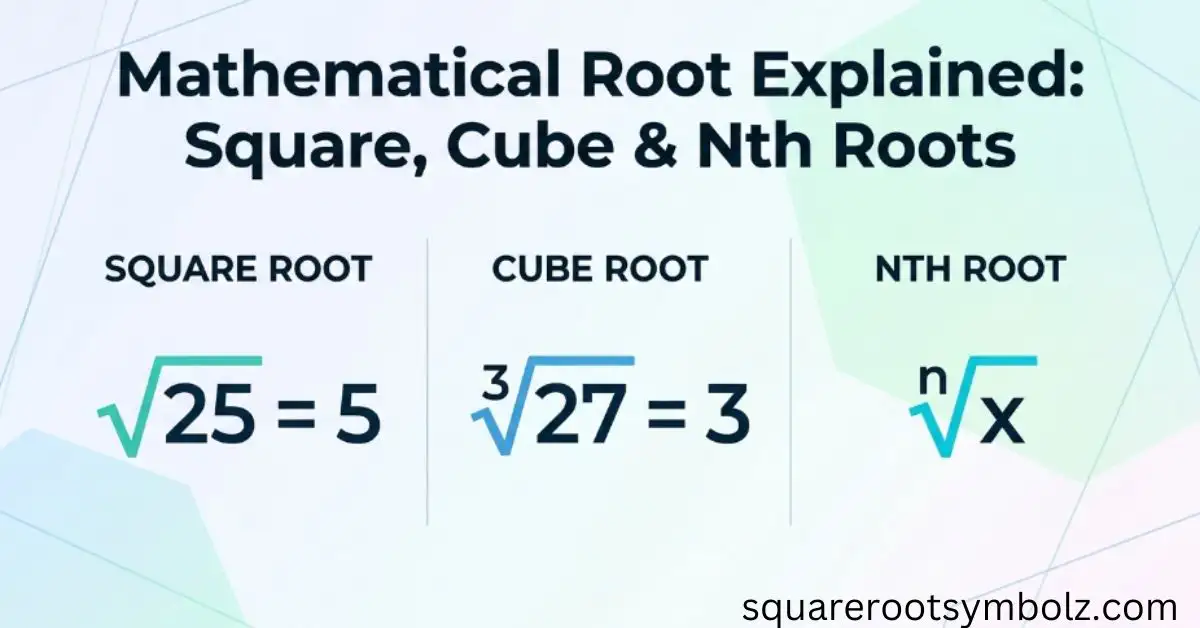
A mathematical root is a number that produces a given value when raised to a specified power. In other words, a root reverses exponentiation: the square root undoes squaring, the cube root undoes cubing, and an nth root undoes a power of n. This connects roots, powers, exponents, radicals, indices, and fractional exponents in one idea.
If roots have ever seemed confusing because of symbols like √, negative answers, irrational numbers, or expressions such as x1/3, the underlying idea is actually simple. A root asks one practical question: “What number, raised to this power, gives me the number I started with?” Once that relationship clicks, square roots, cube roots, nth roots, and radicals become much easier to handle.
Roots: Undoing the Power
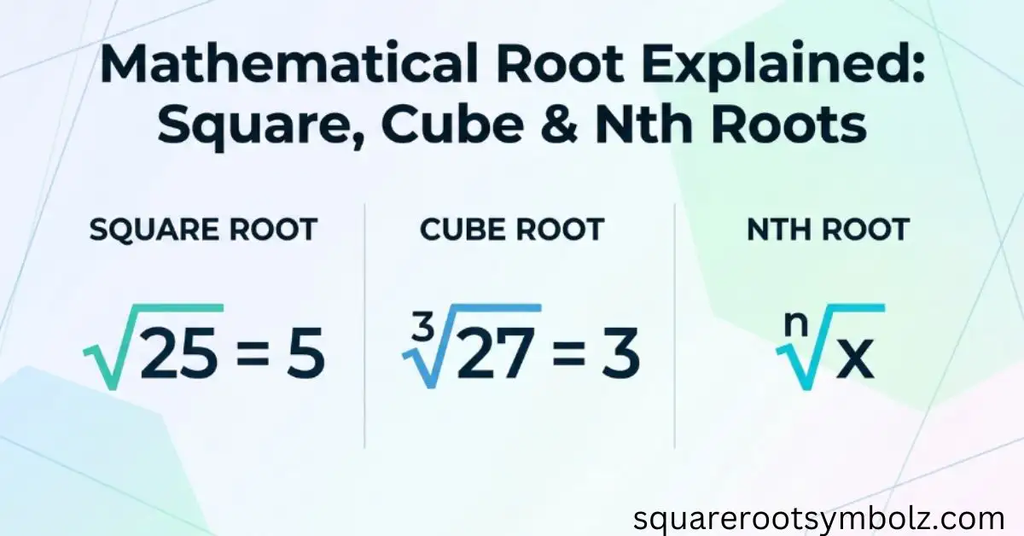
A root is the inverse operation of a power. For example, 42=16, so taking the square root reverses that operation: 16=4. Likewise, because 33=27, the cube root of 27 is 3. This inverse relationship is the central idea behind mathematical roots.
The pattern continues for higher roots. If 25=32, then 2 is the fifth root of 32. In general, the nth root asks for the number that becomes the given value after being raised to the nth power. This makes roots closely connected to exponents, powers, inverse operations, and fractional indices.
| Power | Root | Example |
| n2 | Square root | 25=5 |
| n3 | Cube root | 327=3 |
| n4 | Fourth root | 416=2 |
| n5 | Fifth root | 532=2 |
| nn | nth root | nx |
A useful mental shortcut is to think of powers as building a number and roots as undoing that construction. Multiplication repeatedly creates a power; the corresponding root travels backward to find the original base.
Square Root of a Number
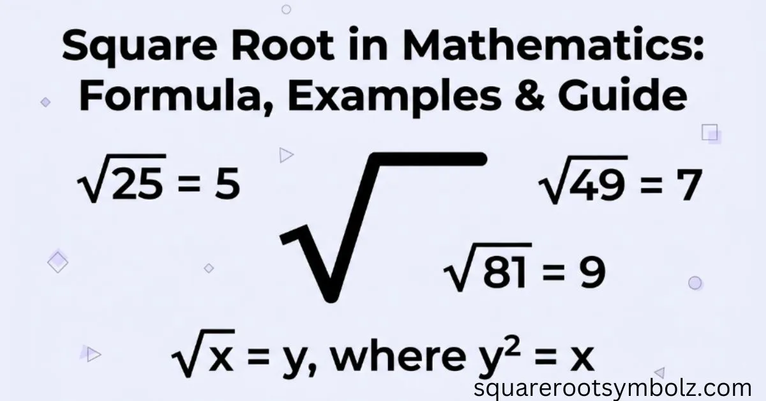
A square root of a number is a value that, when multiplied by itself, produces that number. For example, both 5 and −5 are square roots of 25 because 52=25 and (−5)2=25. For a positive number, therefore, there are two square roots: one positive and one negative.
There is an important convention, though. The radical symbol √ represents the principal square root, which is the nonnegative root. Thus, 25=5, while the two solutions to x2=25 are x=5 and x=−5. This distinction prevents a common mistake when moving between a root expression and an equation.
| Expression | Result |
| 9 | 3 |
| 25 | 5 |
| 64 | 8 |
| −64 | −8 |
| x2=64 | x=±8 |
Zero behaves differently. Since 02=0, zero has only one square root: 0. A negative number has no real square root because squaring any real number produces a nonnegative result.
Square Root Notation
The standard notation for a square root is √x. The symbol itself is called the radical sign, while the quantity inside or underneath it is called the radicand. In 36, for example, √ is the radical sign and 36 is the radicand.
For roots higher than a square root, an index appears on the radical. The cube root is written 3x, while a general nth root is written nx. The index tells you which power you are reversing; when the index is 2, it is normally omitted.
| Notation | Name | Meaning |
| x | Square root | x1/2 |
| 3x | Cube root | x1/3 |
| 4x | Fourth root | x1/4 |
| nx | nth root | x1/n |
This notation also explains why roots can be rewritten as fractional exponents. The denominator of the exponent identifies the root: x1/2 means square root, x1/3 means cube root, and x1/n means nth root.
Perfect Squares Review
A perfect square is a number that results from squaring an integer. Familiar examples include 1, 4, 9, 16, 25, 36, 49, 64, 81, and 100. Their square roots are whole numbers, which makes them especially useful when learning roots and simplifying radical expressions.
For example:
1=12 4=22 9=32 16=42 25=52
Recognizing these numbers quickly can make algebra much easier. If you see 49, you do not need a calculator because 49 is a perfect square and 72=49. Therefore, 49=7.
| Perfect square | Square root |
| 1 | 1 |
| 4 | 2 |
| 9 | 3 |
| 16 | 4 |
| 25 | 5 |
| 36 | 6 |
| 49 | 7 |
| 64 | 8 |
| 81 | 9 |
| 100 | 10 |
Not every positive number has a whole-number root. For instance, 5 lies between 2 and 3 because 5 lies between 22=4 and 32=9. Its decimal value is irrational rather than a neat integer.
The Product Property of Radicals
One of the most useful rules for simplifying square roots is the product property of radicals:
ab=a⋅b
for nonnegative real numbers a and b. This lets you separate a radicand into factors so that a perfect square can be removed from under the radical.
Consider:
72
The largest perfect-square factor of 72 is 36:
72=36×2
Therefore:
72=36×2=362=62
This is why recognizing perfect squares and factors is so valuable. You are not changing the value of the expression; you are simply rewriting the same root in a simpler exact form.
The same idea works with cube roots and other roots when the corresponding factor is a perfect cube or higher power.
Systematic Method: Prime Factorization
When the largest perfect-square factor is not obvious, prime factorization gives you a dependable method. Break the radicand into prime factors, pair identical factors, and move one member of each pair outside the square root.
For example:
252=22×32×7
Therefore:
252=22×32×7
The pairs 22 and 32 come outside:
252=2×37
So:
67
The underlying rule is simple: every pair of identical prime factors contributes one factor outside a square root. Any unpaired factor stays underneath the radical.
This method becomes especially helpful with larger numbers because guessing a perfect-square factor can become inefficient. Prime factorization gives you a repeatable process rather than relying on memory.
Using Rational Roots
Square roots are only one member of the root family. A cube root reverses cubing, a fourth root reverses raising a number to the fourth power, and an nth root reverses raising a number to the nth power.
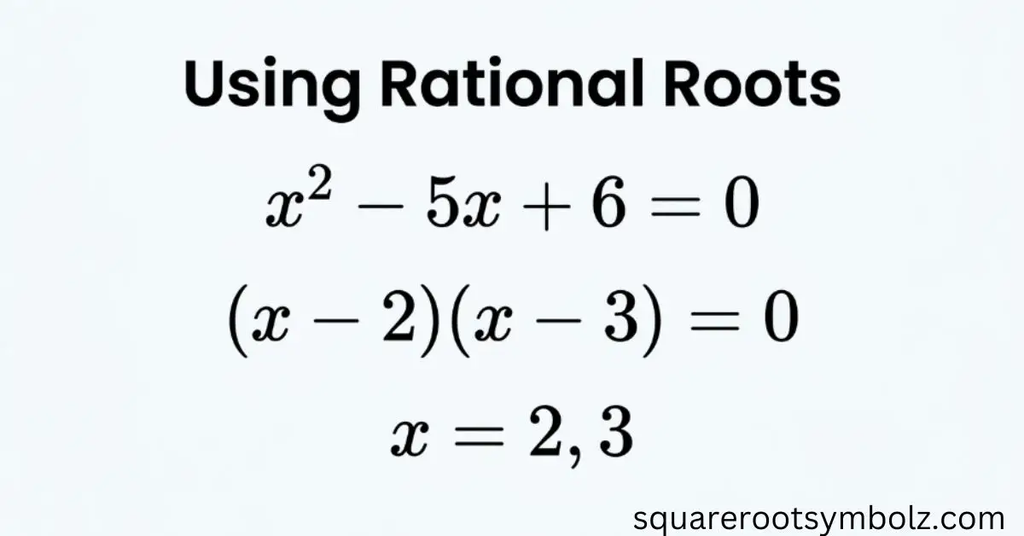
The general relationship is:
na=a1/n
For example:
327=3
because:
33=27
And:
481=3
because:
34=81
The index tells you exactly which power is being reversed.
| Root | Fractional exponent |
| x | x1/2 |
| 3x | x1/3 |
| 4x | x1/4 |
| nx | x1/n |
There is an especially useful connection with fractional exponents:
am/n=(na)m
The denominator gives the root, while the numerator gives the power. For example:
272/3=(327)2=32=9
This relationship makes roots much easier to understand once you are comfortable with exponent rules.
Working with Surds
A surd is an exact radical expression that represents an irrational number. For example, 2 is a surd because its decimal representation does not terminate or repeat. In contrast, 9=3 is rational and therefore is not a surd.
Surds are often simplified by finding the largest perfect-square factor. For example:
20
can be written as:
4×5
so:
20=25
The result is still exact. Writing 25 is often preferable to replacing it with a rounded decimal because no precision has been lost.
Surds also appear in geometry, algebra, trigonometry, physics, and formulas involving distances. Learning to simplify them is therefore more than an exam trick—it is a useful way to preserve exact mathematical values.
Quick Mathematical Root Reference
| Concept | Formula | Example |
| Square | x2 | 52=25 |
| Square root | x | 25=5 |
| Cube | x3 | 33=27 |
| Cube root | 3x | 327=3 |
| nth power | xn | 25=32 |
| nth root | nx | 532=2 |
| Fractional exponent | x1/n | 161/2=4 |
Mathematical Root and Negative Numbers
The behavior of a root depends on whether its index is even or odd. For even roots such as square roots, a negative real number has no real root. For example:
−9
is not a real number.
Odd roots behave differently. A negative number can have a real cube root:
3−8=−2
because:
(−2)3=−8
This difference is fundamental when working across the real and complex number systems. OpenStax likewise notes that even roots of negative numbers are not real, while odd roots can produce real values.
Mathematical Root vs. Root of an Equation
There is another meaning of root that is important in algebra. A root of a function or equation is a value of the variable that makes the function equal to zero. For example:
f(x)=x−5
has a root at:
x=5
because:
f(5)=5−5=0
So don’t confuse these two closely related meanings:
| Term | Meaning |
| Square root of 25 | A number whose square is 25 |
| Root of f(x) | A value that makes f(x)=0 |
| nth root | Number whose nth power gives the target |
| Root of a polynomial | Solution/zero of the polynomial |
The terminology is connected historically and algebraically, but the context tells you which meaning is intended.
Conclusion
A mathematical root is best understood as the inverse of a power. Square roots undo squaring, cube roots undo cubing, and nth roots undo powers of n. Once you understand the connection between roots, exponents, radicals, indices, radicands, and fractional powers, the entire topic becomes much more logical.
The most important distinction to remember is that √x represents the principal square root, while an equation such as x2=25 has two real solutions, x=±5. From perfect squares to irrational surds and higher roots, the same inverse-operation idea keeps appearing and that is the key that makes roots easier to master.
FAQ Section
These questions reflect the major question patterns currently appearing around root-focused SERPs, including explicit FAQ material asking what a mathematical root is, how roots relate to powers, and how negative roots behave.
What is a mathematical root?
A mathematical root is a number that, when raised to a specified power, produces the original value. For example, 5 is a square root of 25 because 52=25.
What is the difference between a root and a power?
A power raises a number to an exponent, while a root reverses that operation. Squaring and square rooting are inverse operations.
What is a square root?
A square root is a number that, when multiplied by itself, gives the original number. For example, 62=36, so 6 is a square root of 36.
What is a cube root?
A cube root is a number that produces a value when multiplied by itself three times. For example, 327=3.
What is an nth root?
The nth root of x is a number y such that yn=x. It is written as nx.
Can a mathematical root be negative?
Yes. Odd roots of negative numbers can be real, such as 3−8=−2. Even roots of negative real numbers are not real.
Does every positive number have two square roots?
Every positive real number has two square roots: one positive and one negative. However, the radical symbol x conventionally denotes only the nonnegative, or principal, square root.
What is a principal square root?
The principal square root is the nonnegative square root of a nonnegative number. Thus, the principal square root of 49 is 7, not −7.
What is the number under a root called?
The number or expression under the radical is called the radicand. In 25, 25 is the radicand.
What does the index of a root mean?
The index tells you which power the root reverses. An index of 2 means square root, 3 means cube root, and 4 means fourth root.
How are roots related to fractional exponents?
An nth root can be written as a fractional exponent:
nx=x1/n
The denominator of the fractional exponent identifies the root.

I’m the creator of SquareRootSymbolz.com, where I publish easy-to-understand guides on symbols, Unicode characters, Alt codes, keyboard shortcuts, and copy-and-paste text symbols. My goal is to provide accurate, well-researched, and user-friendly content that helps readers quickly find the information they need.