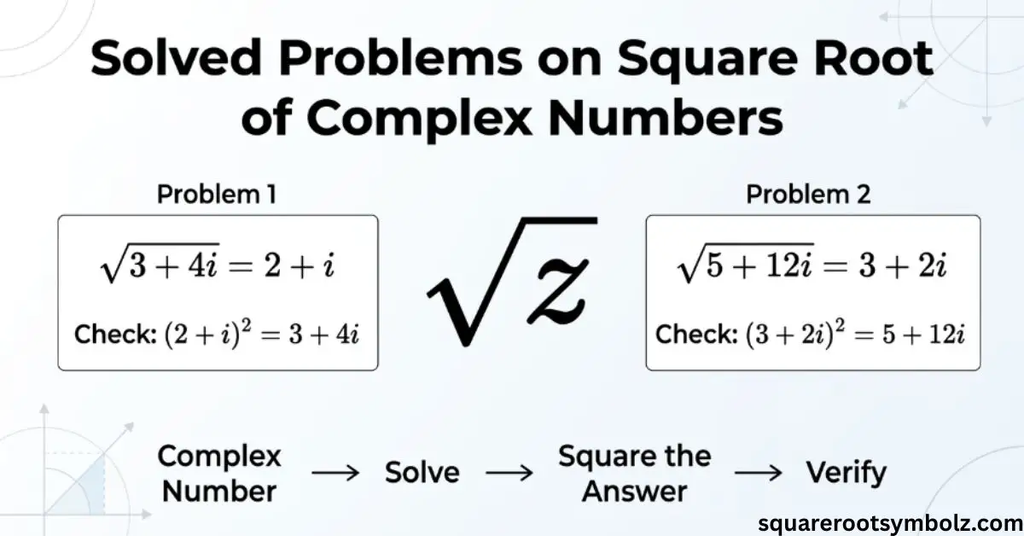
The square root of a complex number is another complex number whose square gives the original value. For example, (3 + 2i)² = 5 + 12i, so the two square roots of 5 + 12i are 3 + 2i and −3 − 2i.
At first, complex roots can look intimidating because they combine a real part, imaginary part, modulus, argument, and the imaginary unit i. But the calculation follows a clear pattern. You can solve it algebraically by setting the root equal to x + yi, or use a compact formula or polar form when the problem calls for it.
How to take a square root of a complex number
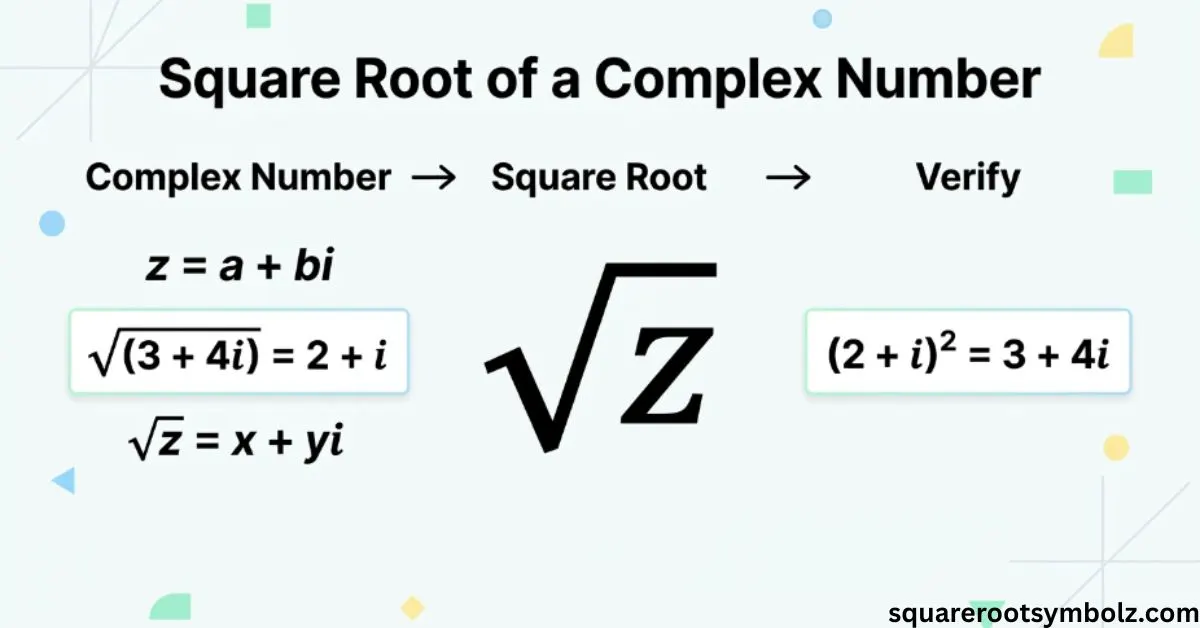
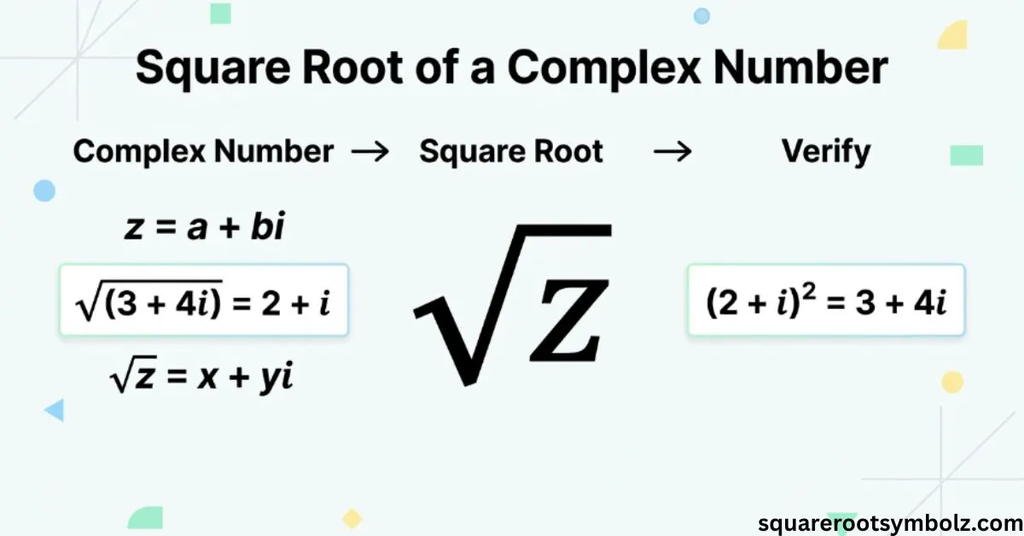
Suppose the complex number is:
z = a + bi
We want to find:
√z = x + yi
The key is to square the proposed root:
(x + yi)² = x² + 2xyi + y²i²
Because i² = −1:
(x + yi)² = x² − y² + 2xyi
Now compare this with a + bi. The real and imaginary components must match, giving:
x² − y² = a
2xy = b
This is the central algebraic relationship used to calculate a complex square root.
A useful way to think about it is that you are not really “taking a radical” in the same way you would with a positive real number. Instead, you are searching for a complex number whose multiplication with itself reproduces both components of the original number.
Square Root of a Complex Number (Algebraic Method)
The algebraic method starts by assuming:
√(a + bi) = x + yi
Squaring gives:
x² − y² + 2xyi = a + bi
Equating corresponding components produces:
x² − y² = a
2xy = b
From the second equation:
y = b/(2x)
Substitute that into the first equation. This produces an equation involving x², which can then be solved. This approach is explicitly developed by GeeksforGeeks and Algebra.com.
A faster formula
For:
z = a + bi
let:
|z| = √(a² + b²)
Then the square roots can be written compactly as:
√z = ± [ √((|z| + a)/2) + i·sgn(b)√((|z| − a)/2) ]
for b ≠ 0.
This formula is especially useful because it avoids solving a separate quadratic equation every time. GeeksforGeeks derives the same relationship from the algebraic equations.
Example: √(3 + 4i)
First calculate the modulus:
|z| = √(3² + 4²)
= √25
= 5
Now:
x = √((5 + 3)/2)
= √4
= 2
For the imaginary component:
y = √((5 − 3)/2)
= √1
= 1
Therefore:
√(3 + 4i) = ±(2 + i)
Check:
(2 + i)²
= 4 + 4i + i²
= 4 + 4i − 1
= 3 + 4i
So the result is correct.
Square Root of a Complex Number (Polar Form)
A complex number can also be expressed in polar form:
z = r(cos θ + i sin θ)
where r is the modulus and θ is the argument.
The square root then follows a remarkably simple pattern:
√z = ±√r [cos(θ/2) + i sin(θ/2)]
The modulus is square-rooted, while the angle is divided by two. This works because squaring a complex number squares its magnitude and doubles its argument.
Example: √(e^(iπ/3))
Here:
r = 1
and:
θ = π/3
Therefore:
√z = ±[cos(π/6) + i sin(π/6)]
Using the familiar exact values:
cos(π/6) = √3/2
sin(π/6) = 1/2
we obtain:
√z = ±(√3/2 + i/2)
The polar approach is especially convenient when the modulus and argument are already known or have simple trigonometric values.
How to compute the square root of a complex number
For computational work, there is a particularly convenient formula. Let:
z = x + iy
and define:
ℓ = √(x² + y²)
Then:
u = √((ℓ + x)/2)
and:
v = sign(y)√((ℓ − x)/2)
so a square root is:
w = u + iv
with the other root being its negative. John D. Cook demonstrates this method using 5 + 12i.
For z = 5 + 12i:
ℓ = √(5² + 12²)
= √169
= 13
Then:
u = √((13 + 5)/2)
= √9
= 3
and:
v = √((13 − 5)/2)
= √4
= 2
Therefore:
√(5 + 12i) = ±(3 + 2i)
Verification is quick:
(3 + 2i)² = 9 + 12i + 4i²
= 9 + 12i − 4
= 5 + 12i
Exactly as required.
Solved Problems on Square Root of Complex Numbers
Worked examples are one of the best ways to see the formula become practical.
Example 1: √(4 + 3i)
Calculate:
|z| = √(4² + 3²) = 5
Then:
x = √((5 + 4)/2) = √(9/2)
and:
y = √((5 − 4)/2) = √(1/2)
Thus:
√(4 + 3i) = ±(3/√2 + i/√2)
This can also be written:
±(3√2/2 + i√2/2)
GeeksforGeeks works through this example algebraically and reaches the same result.
Example 2: √(−3 + 4i)
First:
|z| = √((-3)² + 4²)
= √25
= 5
Then:
x = √((5 − 3)/2) = 1
and:
y = √((5 + 3)/2) = 2
Because the imaginary component is positive:
√(−3 + 4i) = ±(1 + 2i)
Verification:
(1 + 2i)² = 1 + 4i + 4i²
= 1 + 4i − 4
= −3 + 4i
Correct.
Example 3: √(−4)
A negative real number is a special but familiar case:
√(−4) = ±2i
because:
(2i)² = 4i² = −4
This is an important bridge between ordinary square roots and complex numbers. A negative real number does not have a real square root, but it does have complex square roots.
General Formula for nth Root of Complex Number
The square root is actually a special case of a broader rule for complex roots.
Write a complex number in polar form:
z = r(cos θ + i sin θ)
The nth roots are:
z_k = ⁿ√r [cos((θ + 2kπ)/n) + i sin((θ + 2kπ)/n)]
where:
k = 0, 1, 2, …, n − 1
For a square root, n = 2, so there are two roots. Their arguments differ by π, meaning they point in opposite directions on the complex plane.
This explains something that often surprises beginners: unlike the principal square root notation used for nonnegative real numbers, a complex number generally has two square roots. If one root is w, the other is −w, because:
(−w)² = w²
Numerical issues
When you calculate complex square roots with software, the mathematics is only part of the story. Computer arithmetic uses finite-precision numbers, so extremely large or small values can introduce numerical problems.
For example, calculating:
√(x² + y²)
directly can overflow when x and y are very large. John D. Cook notes that a hypot function can calculate the hypotenuse-style quantity more safely in computational environments.
For ordinary classroom problems, this is rarely an issue. But in programming, engineering, scientific computing, or numerical analysis, stability matters. A mathematically correct formula can still produce unreliable machine results if intermediate calculations exceed the limits of the floating-point representation.
Square Root of Complex Numbers
The most important idea is simple: to find the square root of a complex number, find a complex value that squares back to the original number.
For z = a + bi, you can use the algebraic form:
√z = x + yi
and solve:
x² − y² = a
2xy = b
Or, for faster calculations, use the modulus-based formula:
√z = ± [√((|z| + a)/2) + i·sgn(b)√((|z| − a)/2)]
For polar-form problems, use the magnitude-and-angle method instead.
The best method depends on the problem. Algebraic form is excellent for understanding why the formula works. Polar form is elegant when angles are simple. The direct modulus formula is usually fastest for numerical calculations.
Conclusion
The square root of a complex number may look complicated at first, but the underlying idea is straightforward: find a complex number whose square equals the original number. For a + bi, write the root as x + yi, square it, and equate the real and imaginary parts.
For practical calculations, the modulus-based formula is usually the quickest route, while polar form provides an elegant geometric interpretation. Remember that every nonzero complex number has two square roots, which are negatives of each other. Once you understand the relationship between the real part, imaginary part, modulus, argument, and complex plane, these problems become much more predictable.
FAQ Section
What is the square root of a complex number?
It is a complex number w such that w² = z. Every nonzero complex number has two square roots, w and −w.
How do you find the square root of a + bi?
Let the root equal x + yi, square it, and equate real and imaginary components:
x² − y² = a and 2xy = b.
What is the formula for the square root of a complex number?
For z = a + bi, let |z| = √(a² + b²). Then:
√z = ±[√((|z|+a)/2) + i·sgn(b)√((|z|−a)/2)].
This is the direct form used in standard complex-number calculations.
What is the square root of 3 + 4i?
The answer is:
±(2 + i)
because (2 + i)² = 3 + 4i.
What is the square root of 5 + 12i?
The two square roots are:
±(3 + 2i)
because (3 + 2i)² = 5 + 12i.
Can a negative number have a square root?
Yes, in the complex-number system. For example:
√(−9) = ±3i
because i² = −1.
How does polar form find a complex square root?
If z = r(cos θ + i sin θ), then:
√z = ±√r[cos(θ/2) + i sin(θ/2)].
The magnitude is square-rooted and the argument is halved.
Are complex square roots always real?
No. A complex number can have a purely real, purely imaginary, or genuinely complex square root depending on its value.
Why are there two square roots?
If w² = z, then (-w)² = z as well. Therefore, every nonzero complex number has two square roots that are opposites.

I’m the creator of SquareRootSymbolz.com, where I publish easy-to-understand guides on symbols, Unicode characters, Alt codes, keyboard shortcuts, and copy-and-paste text symbols. My goal is to provide accurate, well-researched, and user-friendly content that helps readers quickly find the information they need.